
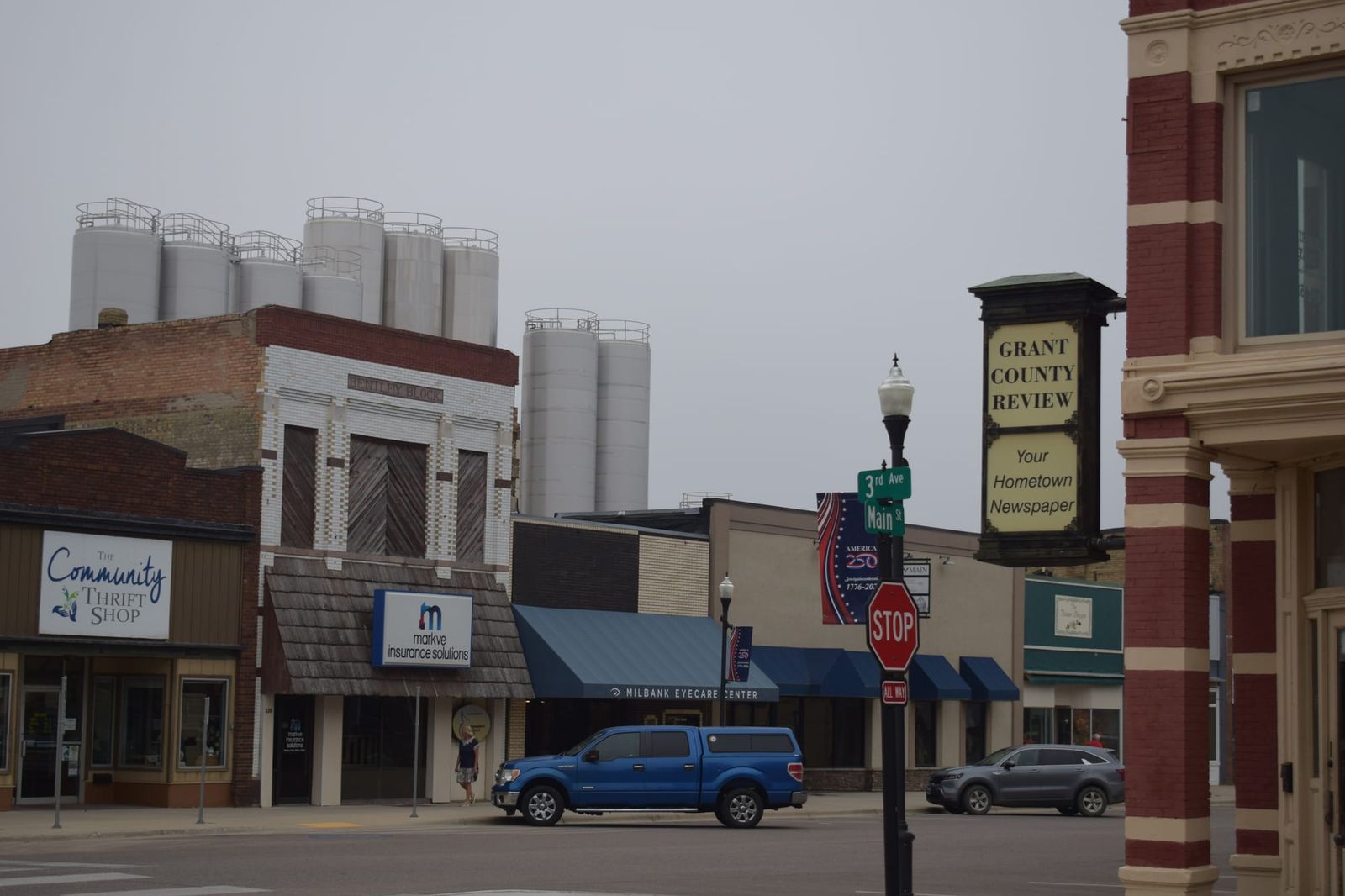
How a 20-year-old precedent has shaped the way rural schools keep up with declining enrollment rates. About 60 students from Minnesota now attend school in the Milbank School District – nearly 6% of the student body.

MILBANK, S.D. – It was more than twenty years ago that the South Dakota Department of Education partnered with its neighbor to the north to allow what the state called a "groundbreaking" initiative to support public school students in rural areas.
The partnership, signed in 2005, allowed students in both North and South Dakota to attend public schools in the other state if their district sits on the border, supplementing a lack of nearby public school access in some of both states' most rural areas. That was followed in 2009 by an agreement with Minnesota, and in 2011, an agreement with Iowa.
Jaeya Jones, public information officer for the South Dakota Department of Education told News Watch that the state does not keep track of exactly how many students are enrolled in South Dakota public schools from out-of-state, or vice versa.
"The department is aware that school districts across the state form local partnerships. However, the department does not track these as they are a local control decision and agreement," Jones said in a statement.
Those partnerships reflect a question that many schools in rural border towns still face decades later: How to keep attendance levels up, which is critical to both increased funding and keeping schools open as the state gets stricter about public school enrollment numbers.


Out-of-staters provide needed enrollment boost in rural schools
There are a number of schools in the state that source some of their students from small towns on the other side of the border. Many of them lie in the northeast corner of the state, which borders both Minnesota and North Dakota.
For years, some students in Minnesota attended school in Big Stone City – the town sits on the Minnesota-South Dakota border. Ortonville, a town just a mile away also bordering Big Stone Lake, and Big Stone City have formed a close relationship.
Last year, though, the Big Stone City school, which was then just a K-8 school, closed its doors after the 2024-25 year. Those Minnesota families were faced with a decision to either return to the state to educate their kids, many of whom had spent the majority of their lives in the South Dakota education system, or send them a bit farther down the road.
Milbank, which sits about 10 miles from Big Stone City, has taken on the school's students. Justin Downes, superintendent of the Milbank School District, said that along with Big Stone City students, the district has seen an increase in out-of-state students more generally.
Downes estimates that about 60 students from Minnesota attend school in the Milbank School District – making up nearly 6% of the student body.
Importantly, the agreement between South Dakota and Minnesota says that students living in Minnesota enrolled in a South Dakota district will be counted toward that South Dakota district's state aid calculation, meaning those students will help the district get more much-needed state funding.
The Minnesota-South Dakota also agreement says that if more students from Minnesota come to South Dakota for school, or vice versa, the state sending more students will give money to the receiving state's Department of Education per student "as reflecting the average general education revenue per ADM (average daily membership) from state aids and local property taxes."
"That's pretty significant, and we did see a lot of growth this year in that for kids that live near the border. Milbank's got a lot to offer, and we've had a lot of Minnesota kids choose to come to school in Milbank, and we welcome all of them," Downes said.
While the move required a bit of reorganization in staff, Downes said the school has been through this before. In 2017, the dissolution of Grant-Deuel school district sent its students to Milbank, Waverly South Shore and Clear Lake school districts. Prior to that closure, Grant-Deuel had a joint powers agreement with Milbank and sent its students there for some classes.
Get free, fact-based South Dakota news and information in a weekday email. No spam. Cancel any time.
"As these small schools get smaller, pretty much all of our schools in the state are getting smaller. And as we get smaller, sometimes hard decisions are going to be made along the way on programming. We're pretty fortunate to still have all that programming," Downes said.
The closures of smaller rural schools have provided enrollment boosts to mid-sized districts like Milbank – which, like many others, has seen attendance declines. In the 2024-25 school year, enrollment in Milbank slipped below 1,000 for the first time since 2019, with 971 students enrolled. The 2025-26 school year – the first after Big Stone City's closure – saw 1,008. Enrollment numbers for this year have not been formalized yet, but Downes estimates it's around 1,020.
"Obviously our funding is tied to enrollment, and so it definitely helped in a lot of ways financially. But it also culturally has been a really good adjustment. The kids fit in really well together," Downes said.
"Staffing-wise, we made a couple of slight adjustments. But overall, when you take 60 kids divided by nine grades, spread out amongst three or four sections, and we can get them to fit in pretty good."
Partnerships extend to athletics, other education opportunities
There are still a few further collaborations Downes would like to see, though, citing his close relationship with Ortonville School District superintendent Kris Evjes.
A new $8.3 million Career and Technical Education Center in Milbank has been a boon for students in the district, Downes said. He'd like to see students from Ortonville's school district, which has an enrollment of about 500, reap the benefits of that as well.
"I wish we could find a way to make it easier for those kids to be able to take classes. You know, whether it's welding or or robotics or FACS (family and consumer science) and anything in the kitchen, so that we could get those kids in and kind of do a blended schedule for them because we're only 12 minutes apart, you know. There's a lot of schools that are a lot farther away from their attendance centers than that," Downes said.
Complications with credit transfers make that difficult right now, but Downes said he and Evjes are still working together to give students as many opportunities as possible – even if it means crossing state lines.
Downes said he and Evjes communicate frequently to discuss how best to support students in both districts.
And the schools have come together in the past. After Ortonville lost its gymnastics coach in 2017, the two schools agreed to let Ortonville gymnasts compete in South Dakota with the Milbank Lady Bulldogs. Each year, there are at least a few Ortonville natives on the varsity team.
Support stories about rural South Dakota with a tax-deductible donation.
Adding even a few students from other districts can occasionally mean big changes for schools – in South Dakota, gymnastics has just two athletic classes, A and AA. Moving up to a higher class, especially for smaller schools, can mean stiffer competition. Downes doesn't have many concerns about that yet.
"For our size of school, we really don't have a penalty to have that cooperative agreement because we're on the smaller side of (Class) A now. So it would take a lot of kids in order to force us to move up," Downes said.
Combining athletic capabilities is common for small schools. And in other districts those cross-border partnerships also exist, especially for sports with typically lower participation numbers. The Estelline school district, 50 miles south of Milbank, partners with Hendricks, Minnesota, for all of its athletics, sharing costs for facilities, transportation and uniforms. Each school gets to keep the revenue from events held in its facilities. Hendricks is 25 miles and about 30 minutes east of Estelline.
The Hendricks-Estelline partnership, which began in 2018, was born, like many rural schools, out of a need to partner with a school to boost its activities. It seems to be working – the school claimed its fourth straight Class A state gymnastics win last year.
Karola Peterson, an Estelline resident, told News Watch in September that the communities come together frequently for games and events – most of which are held in Estelline – and have bonded over the partnership.
"It's been a good thing for us as well as for them," Peterson said.
South Dakota News Watch is an independent nonprofit. Read, subscribe for free and donate at sdnewswatch.org. Contact reporter/Report for America corps member Molly Wetsch: 605-531-7382/molly.wetsch@sdnewswatch.org.