Community engagement project will identify issues the entire state should know about, people whose voices aren't often heard and grassroots solutions to challenges through in-person visits, reader surveys and virtual gatherings.

South Dakota News Watch celebrates 10 years since its founding this year. That is no small feat at a time when competition for attention is at an all-time high and trust for the media in general is at an all-time low.
The world has changed much since 2016.
But what hasn't changed is people's need to know what's going on in their local community and state. From the start, News Watch has filled gaps in statewide news and information to complement local media outlets and also be a convener of ideas.
Now we're building on that history with an expansion of Engage South Dakota, which we started a couple of years ago to identify grassroots housing solutions around the state.
Because of the success of that community engagement effort, we're broadening the focus to search the entire state for other issues, concerns and solutions that might not be getting the attention they deserve.
As we reported last year, half of South Dakotans now live in the urban areas of Sioux Falls and Rapid City, which means about half the residents are in medium-sized cities, towns, reservations, rural areas and even frontier regions.
The 605 area code is a big, diverse place.
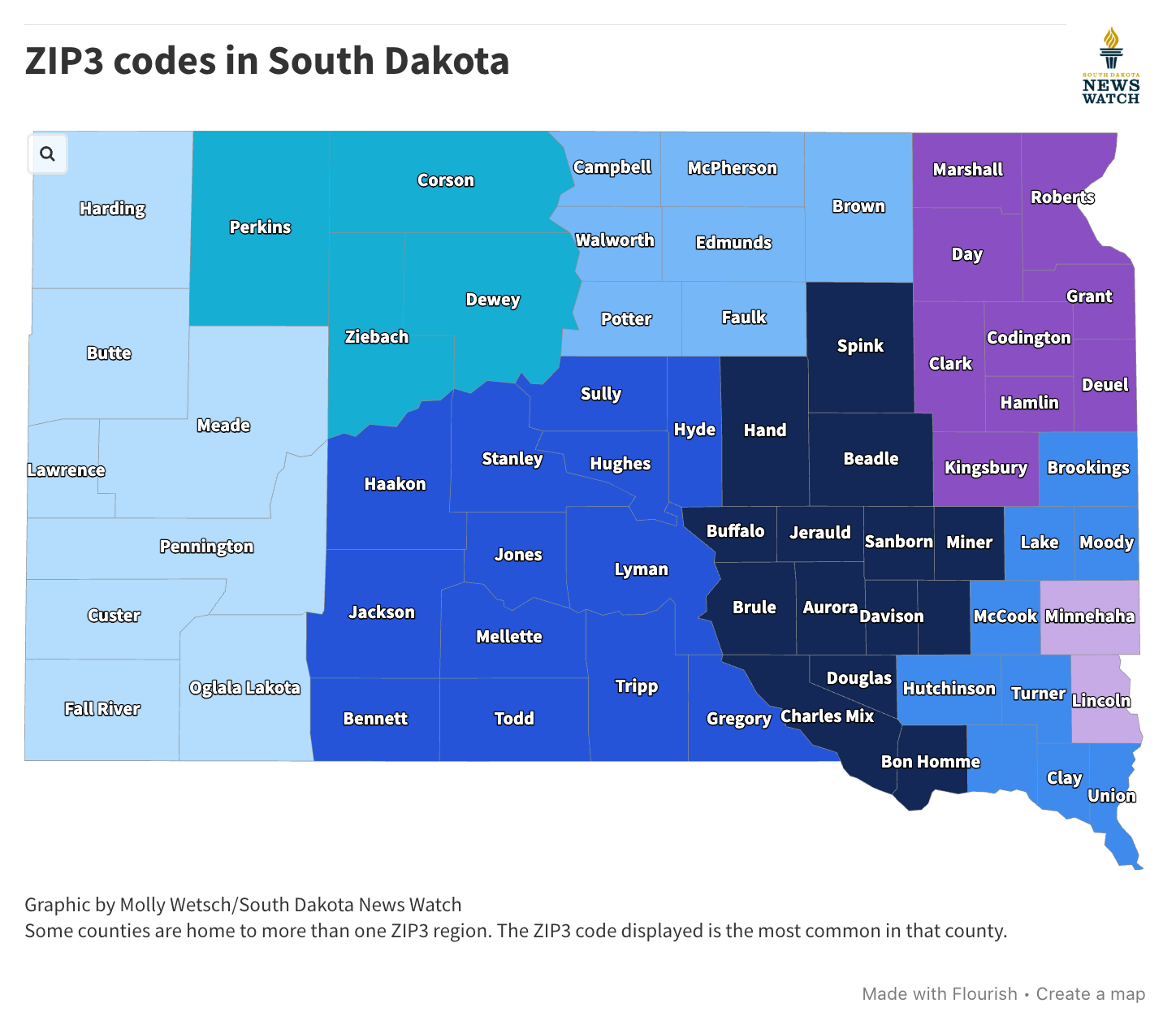
Which is why we're breaking up the effort by ZIP Code. Specifically, the eight ZIP 3 Codes that sort the state by geographic region:
- 570: Southeast
- 571: Sioux Falls
- 572: Northeast
- 573: James River
- 574: North-central
- 575: South-central
- 576: Northwest
- 577: West
ZIP history and the project
The idea to break up the state this way came from several other successful community engagement efforts around the country, including the Nashville Banner's ZIP Code Project. That newsroom has a larger staff and a smaller geographic area to cover, but the goal is the same: have reporters get out in communities and listen.
The U.S. Post Office Department started using ZIP (Zone Improvement Plan) Codes in 1963. The original intent was to simply allow mail sorting methods to be automated, but it morphed into socio-economic uses no postal executive could ever imagine.
Get free, fact-based South Dakota news and information in a weekday email. No spam. Cancel any time.
A 2013 paper by the U.S. Postal Service Inspector General summarizes the evolution well: "The ZIP Code became a social tool for organizing and displaying demographic information, a support structure for entire industries such as insurance and real estate, and even a representation of social identities as observed in the television series 'Beverly Hills, 90210.'"
While the USPS is reeling from delivery and cost challenges, which we've reported, the basic structure of the codes – and their expanded uses – aligns well with this effort because it divides a vast region into smaller segments, each with its own personality.

News Watch reporter Bart Pfankuch launched Engage South Dakota and will continue focusing on housing and other solutions.
In this new effort, reporters Molly Wetsch and Emily DeCock will travel each ZIP 3 Code to identify the top issues and concerns – as well as solutions – and tell the stories of people helping to shape South Dakota.
Here's how Molly describes it: "Semi-structured road trips to communicate with leaders and regular residents, to hear about issues on the ground, get a feel for the culture of communities and gain an understanding of how they are different from other regions. We'll look for state angles through common issues we see throughout the state but take time to explore what makes each region unique."
Emily added: "We hope, as public servants, to be able to be a part of the communities we serve. That can be challenging in a state as large as South Dakota. By visiting diverse areas of the state, we can better inform our coverage and have a touch point with real residents. We want to have open conversations about what's making widespread impacts, while still seeing what's affecting the local, unique regions we visit."
How to be part of it and make your voice heard
The ZIP 3 Code effort offers three ways for all state residents to make their voice heard and guide our coverage:
- A short survey you can take online.
- Video meetings. The first one will be 4 p.m. Central time Tuesday, Oct. 6. Click to join Google Meet (no app needed).
- In-person conversations with our reporters. If you'd like to meet with them when they're in your region, let them know at the bottom of the survey above.
The first story in the series will be published Wednesday and feature people from Watertown, Estelline, Britton and Webster.
South Dakota News Watch is an independent nonprofit. Read, subscribe for free and donate at sdnewswatch.org. Contact CEO Carson Walker: 605-610-9366/ carson.walker@sdnewswatch.org.