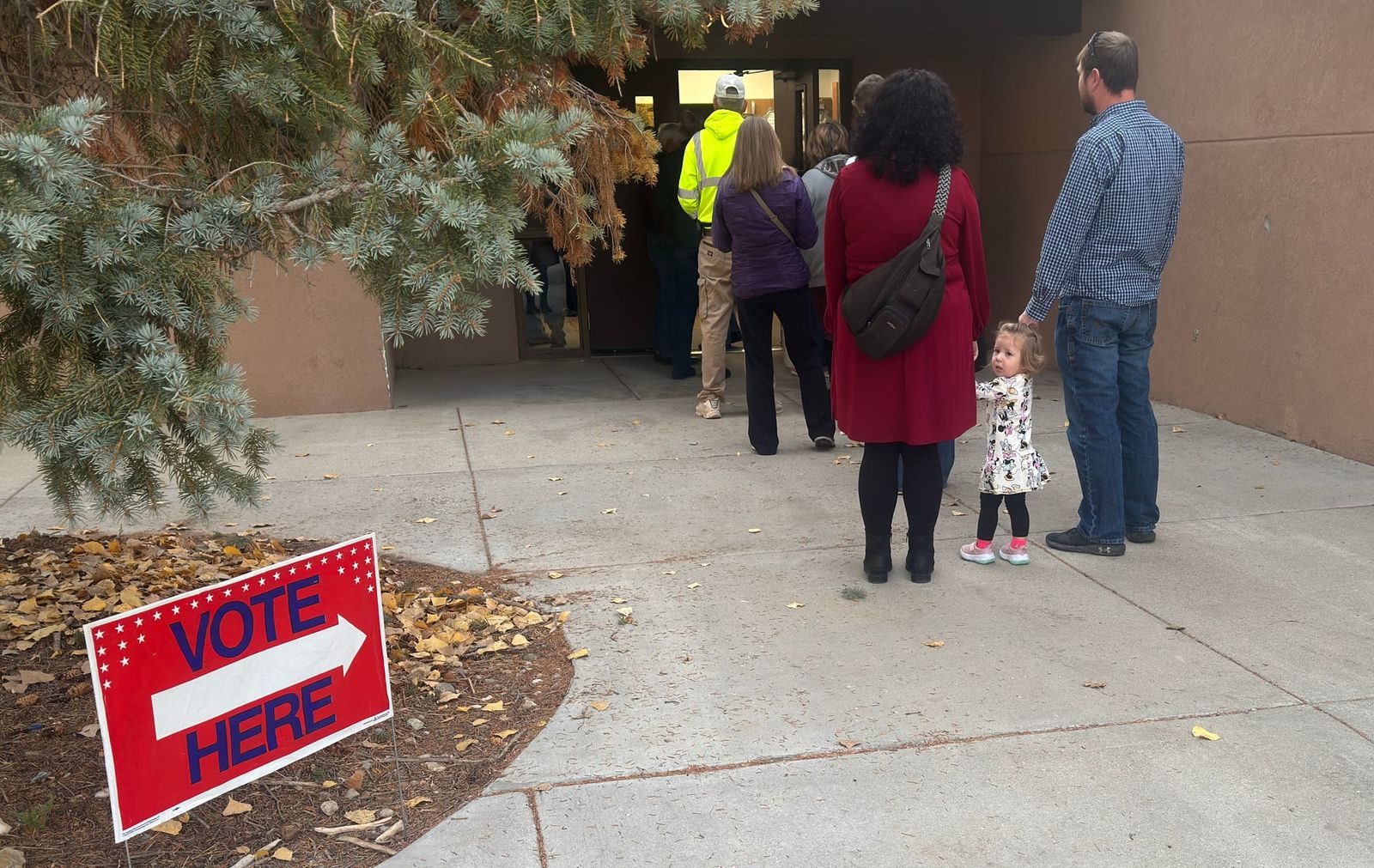
South Dakota county auditors have taken different approaches to navigating a new law requiring proof of citizenship. Meanwhile, early voting appears to be underway.
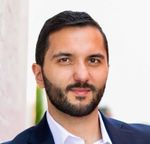
PIERRE, S.D. – County auditors in South Dakota are, in certain cases, deciding how to implement new voter ID rules on their own due to uncertainty over guidelines issued by the state's secretary of state, as early and absentee voting for the primary election is well underway.
Senate Bill 175, passed in the 2026 legislative session, requires new voters to provide proof of citizenship as part of the registration process. The bill was enacted with an emergency clause, which allows the regulations to take effect for the upcoming primary ballot on June 2.
 Alexander Rifaat
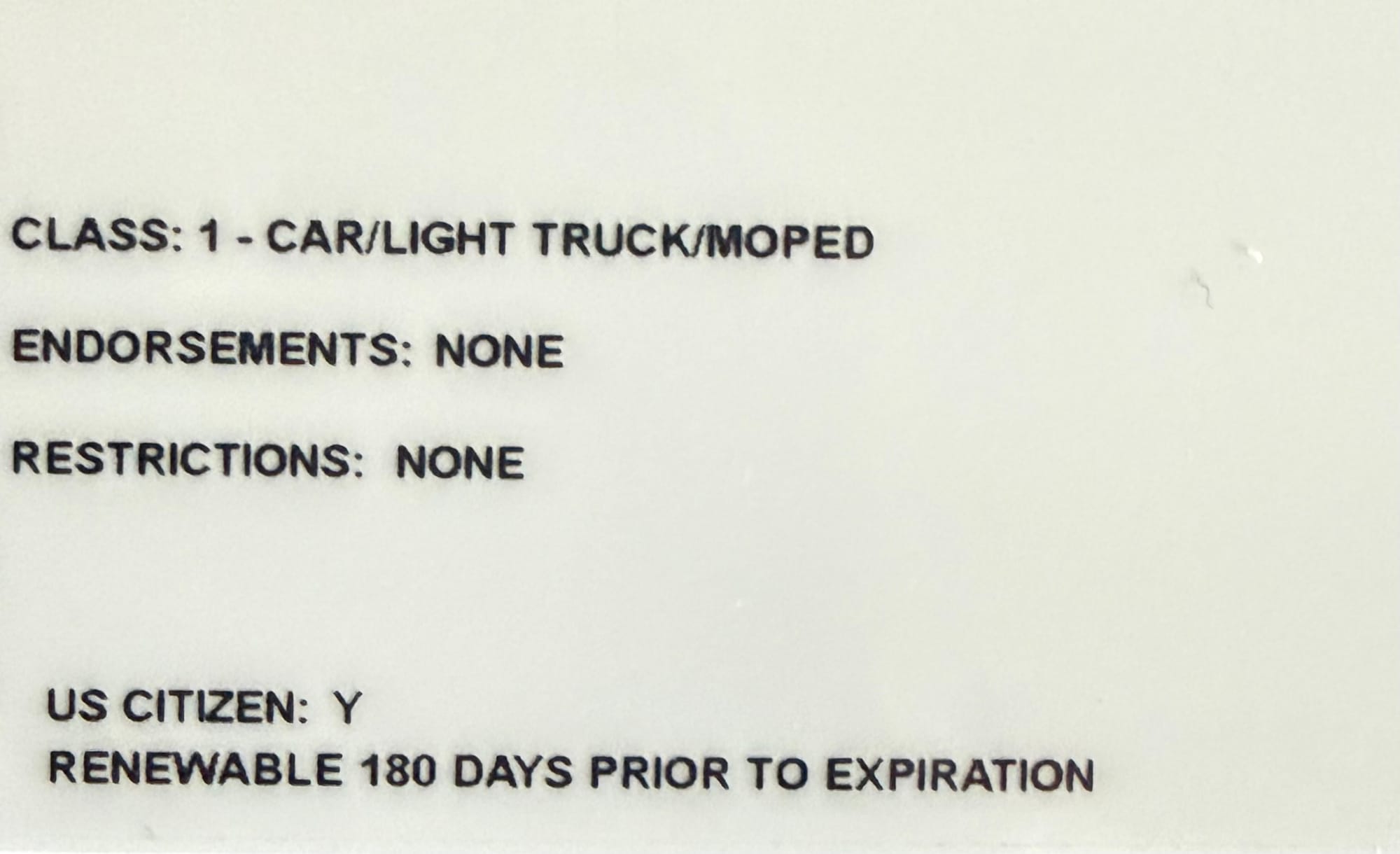
The secretary of state's website outlines various documents first-time registrants can provide as a photocopy to show proof of citizenship, such as a passport or birth certificate. But confusion has emerged as to whether eligible South Dakota driver's licenses, which identify a person's citizenship status, can also be provided as a photocopy or have to be shown in person.
Since July of last year, as a result of Senate Bill 75 from the 2025 legislative session, driver's licenses in South Dakota are now issued with an indication of a person's U.S. citizenship status. The secretary of state's website lists driver's licenses as an acceptable form of proof but does not explicitly state whether they need to be physically shown at an auditor's office or if a photocopy is sufficient.
Get South Dakota news and information in a free email on weekdays. Cancel any time.
Amy Scott-Stoltz, president of the League of Women Voters of South Dakota, a nonpartisan advocacy group, said that county auditors in charge of voter registration are having difficulty ensuring a uniform system across the state.
"They're trying to follow the secretary of state's guidelines, but the vagueness has led to certain issues," Scott-Stoltz told News Watch. "Do they need to present this stuff in person? Can they accept it by mail? Different auditors interpret that differently."
Hughes County Finance Officer Thomas Oliva, who acts as that county's auditor, said his office is requiring new voters to show the physical driver's license.
"The main reasoning behind that is because it's the back of the license. There's no other identifying information on the back we can tie back to that person, so we felt it's in the best interest to see the physical card," Oliva told News Watch.
Haakon County Auditor Stacy Pinney said she has not run into any issues yet with voter registration but also will require new applicants to physically show the driver's license.
"I'm going to make it a policy in my office that I want to see the actual card. If I have to verify it, I want to see the real deal," Pinney told News Watch.
Meanwhile, Harding County Auditor Kathy Glines said her office will accept a photocopy of the driver's license.
"They would have to send a front and back," Glines told News Watch.
"I hope they would call before sending it by mail," she added, referring to the limited hours the office is open.
Need for clarity
In addition to questions over how to process new voter applications using driver's licenses, Oliva said the secretary of state's office has also created confusion in its communication with prospective voters who are missing the required citizenship documentation.
Oliva said voters who are deemed not to have provided proof of citizenship are sent a letter that indicates they are a "Federal Only" voter, which means, since the new voting law applies to South Dakota elections, they can only vote in statewide federal elections for U.S. president, U.S. Senate and the U.S. House of Representatives races.
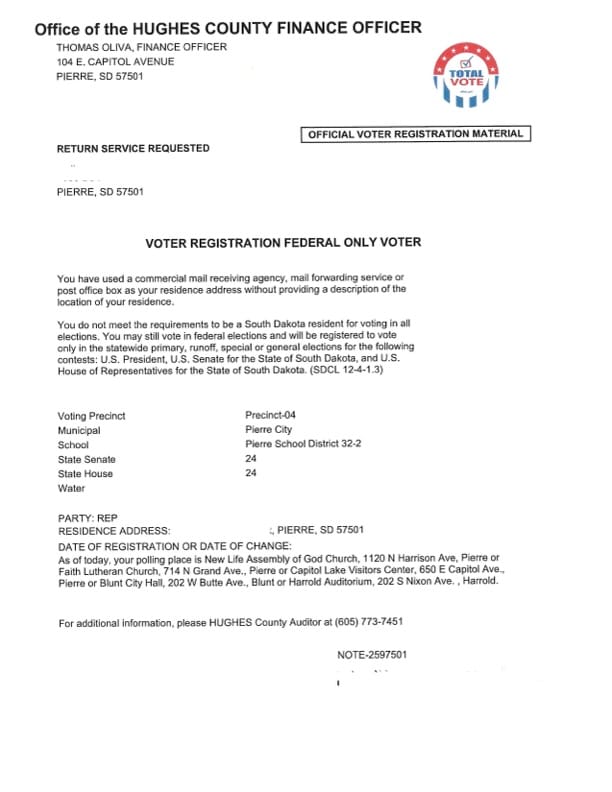
"I do not necessarily agree with this approach and believe the individual should instead be notified and marked as incomplete or invalid until the required documentation is received," Oliva said. "While the letter does inform the voter of their status, it does not provide a clear explanation as to why they were designated as such."
Oliva highlighted the letter generated by the voter registration system only indicates a person is ineligible due to situations such as the use of a commercial mail receiving agency, mail forwarding service or post office box without sufficient residential description.
"While that explanation is accurate in those scenarios, it does not address the separate issue of missing citizenship documentation, which can also result in Federal Only status. This omission may lead to confusion for voters," Oliva said.
In order to provide more clarity, Oliva created a letter addressed for those deemed to be a Federal Only voter based on a lack of proof of citizenship outlining their options.
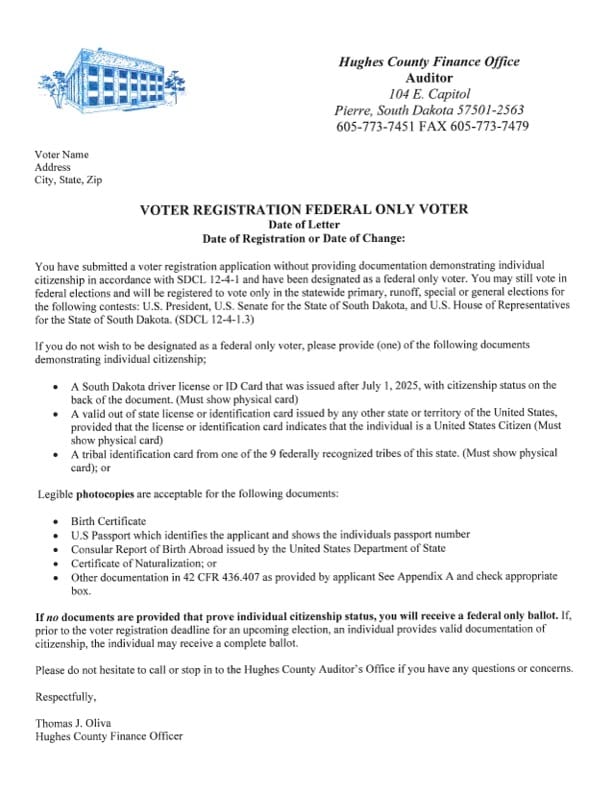
In a copy of the letter provided to News Watch, Oliva's office specifies the new voter was classified as Federal Only due to the lack of citizenship documentation and provides examples of eligible forms of documents they can submit to change their status.
As early and absentee voting for the primary election gets underway, Scott-Stoltz hopes officials in Pierre can provide more certainty on the registration process for new voters.
"We’re hoping for more clarification from the secretary's office before the primary and are looking forward to working with the election board," she said.
The secretary of state's office didn't respond to a request for comment by News Watch.
Ballots delivered; no extra documentation needed to vote
After early and absentee balloting in some counties were delayed in part due to the short time frame the secretary of state's office had in validating eligible candidates, primary voting does appear to be back on track across the state.
News Watch reached out to all 66 county auditors, with 30 so far confirming they have received their absentee primary ballots.
Oliva said the challenges so far have been manageable and that a key focus for his team will be to also emphasize to voters who are already registered that they do not need to present new documents.
Whether it's about how to register and vote or interpret the results, we're here to help you understand the 2026 primary election on June 2.
Email me at alexander.rifaat@sdnewswatch.org or call/text 605-736-4396
"We have received questions and concerns from individuals who believe they must bring additional documentation to the polls in order to vote. This is not the case, and it is important to correct these misconceptions and provide clear, factual information," Oliva said.
Oliva said it's unfortunate not every county is executing the new voting requirements the same but concedes "it's entirely up to that auditor's office."
As for Glines, she said her county is doing the best it can to abide by the secretary of state's guidelines.
"We are all feeling our way through it," Glines said.
Jackley releases explanation on Amendment J
Concerns over the new registration rules come as state Attorney General Marty Jackley issued a draft explanation on an upcoming ballot measure tied to the U.S. citizenship requirement for voting in elections.
Amendment J, which will be on the ballot this November, would amend the South Dakota Constitution to add people who are not U.S. citizens to the list of individuals disqualified from voting.
Proponents of the measure argue it will provide greater clarity as to who can vote since, while non-U.S. citizens are already barred from voting in federal elections and registering to vote in South Dakota, there is no language in the state constitution that explicitly prohibits them from voting in state or local races.
Alexander Rifaat
Under state law, the attorney general is required to issue a draft explanation of the measure, which essentially acts as a preview of how the question will appear on the ballot.
The public has until end of day on May 8 to submit written comment on the attorney general's explanation. A final draft is due to the secretary of state's office on May 19 for approval. The finalized explanation will then accompany the ballot question in the fall.
South Dakota News Watch is an independent nonprofit. Read, donate and subscribe for free at sdnewswatch.org. Contact politics and statehouse reporter Alexander Rifaat: 605-736-4396/alexander.rifaat@sdnewswatch.org.