
A recent federal shift in special education oversight raises uncertainty in future handling of civil cases involving discrimination based on disability.

SIOUX FALLS, S.D. – Parents in South Dakota who believe their child is being discriminated against at school who have not reached a resolution at the local level may turn to the Office of Civil Rights. But a recent federal shift raises questions about the future of special education discrimination in civil lawsuits.
There are currently seven elementary and post-secondary schools under pending investigation filed to the Office for Civil Rights related to disability discrimination as of January 2025, detailed in the graphic below.
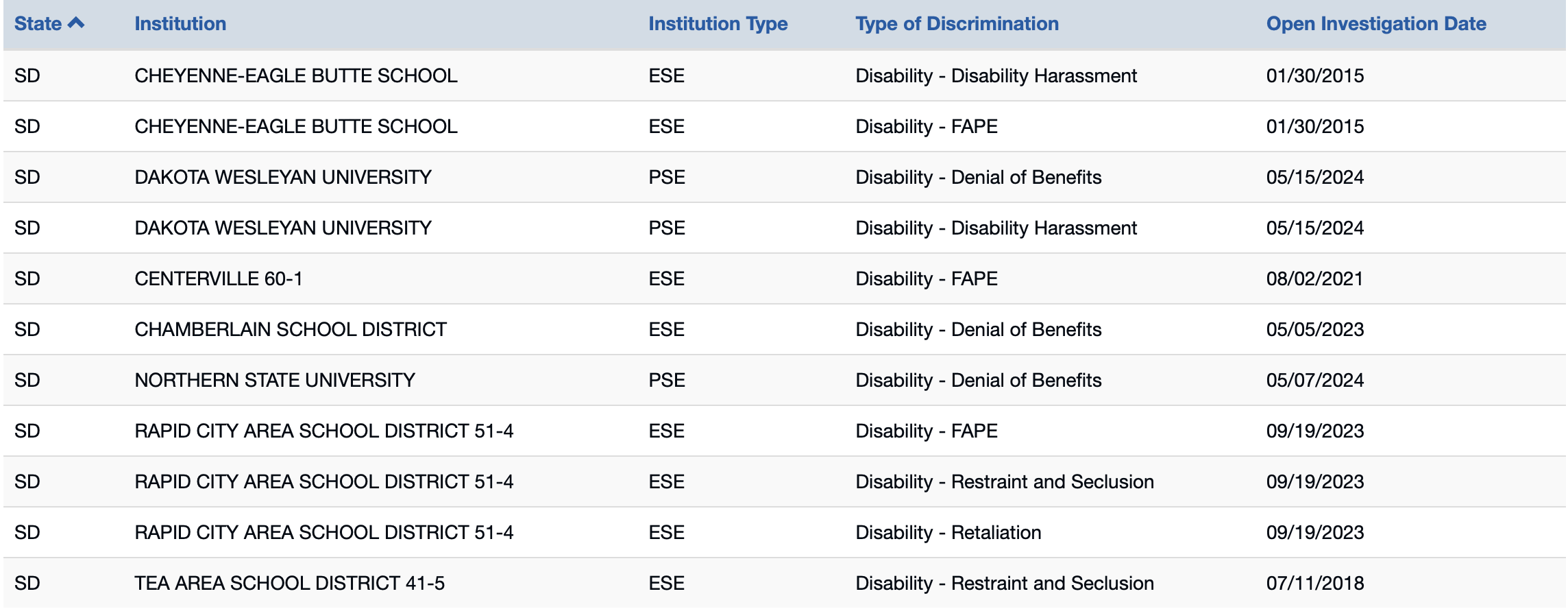
Between 2013 and 2026, there have been 27 resolutions related to disability discrimination in the Office for Civil Rights. Of these 27 resolutions, 25 involved specific school districts or post-secondary learning institutions.
According to publicly available letters published by the Office for Civil Rights, the agency has taken as few as three months and 10 days to as long as five years and three days to return letters of resolution between the years of 2015 and 2022.
Get free, fact-based South Dakota news and information in a weekday email. No spam. Cancel any time.
Among the allegations against school districts, according to published letters of resolution: free appropriate public education (FAPE) violations, not creating and enforcing appropriate accommodations and not properly following 504 plans, which provide a student with a mental or physical impairment with equal access to learning through special accommodations and support.
A freedom of information request (FOIA) was filed in June 2026 requesting records from the Chamberlain School District and Tea Area School District cases that has not yet been fulfilled.
Cases can be handled at state level
Not all special-education disputes go directly to the Office for Civil Rights. Under the Individuals With Disabilities Education Act (IDEA), parents can pursue an administrative due process complaint.
For example, in Marson v. Estelline, a federal lawsuit filed June 3, 2026, plaintiff Heather Marson alleged that the Estelline School District denied their son a FAPE. Her initial complaint filed to the state Oct. 6, 2025, followed an Oct 1. incident in which her son was unsupervised for almost 30 minutes and soiled himself.
The superintendent told the parents in an email two days after the incident that, going forward, having someone with him is the "best way" for him to know where he needs to be. In an email reply to the superintendent, his mother asked, "Why after 5 years of us constantly advocating for a full time aide is one now being provided?"
According to the due process hearing decision, while his Individualized Education Program (IEP) stated he needed staff support for exercise completion, walking and toileting, the IEP did not include accommodations for supervision while traveling between classes.
The district testified during the April 2026 hearing that the supervision had "no educational purpose," and was not needed for FAPE.
The Marsons declined an interview request, due to the pending federal appeal. According to PacerMonitor, the case now sits in the U.S. District Court for the District of South Dakota.
What does this federal shift mean?
Regardless if handled at the federal or local level, the future of education oversight, including special education, in light of ongoing changes raises questions.
The Trump Administration announced in June 2026 a new shift within the Department of Education that reflects ongoing efforts to rearrange and dismantle the Education Department, an effort President Trump said will return power back to the states.
The Department of Justice will hold responsibilities of civil rights in education, and The Department of Health and Human Services will oversee special education. The two offices involved are the Office of Special Education (Department of Health and Human Services) and the Office for Civil Rights (Department of Justice). Both help defend the rights of children with disabilities experiencing discrimination, The Associated Press reported.
 Molly Wetsch
Savannah Newhouse, press secretary for the U.S. Department of Education, said to News Watch in a written statement that the new partnership will not stop the department's staff from executing federal responsibilities.
"The federal government will ensure dollars continue to flow, students with disabilities still receive the services they deserve and civil rights protections remain firmly enforced," Newhouse said.
Children with disabilities are entitled to a free and appropriate education
Under IDEA, originally passed in 1975, children with disabilities are entitled to a free and appropriate education (FAPE). The law ensures they receive special education and related services.
Cole Uecker, executive director of Disability Rights South Dakota, said a free and appropriate public education is a concept that all kids should be able to attend public schools and receive an appropriate and beneficial education.
For example, a child can receive a modified curriculum to help them further develop their knowledge, skills and adaptive behavior just like any other kid.
One way children with special needs are ensured a free and appropriate education can be through an individualized education program (IEP).
An IEP is defined by the Center for Parent and Information Resources as a written statement of an educational program designed to meet a child's individual needs.
At the state level, Laura Scheibe, deputy secretary of the South Dakota Department of Education, said the interagency agreement and shift in the division of special education oversight will not change IDEA's requirements that the state must follow.
However, some disability advocates raise concerns.
Future outcomes are currently unclear
Uecker, with Disability Rights South Dakota, said a concern with the federal shift is how the change will work. He said there are still more questions than there are answers, and he's unsure if the Department of Justice has the bandwith.
"I think there's still a lot of ambiguity around the topic, which makes it very difficult to say one way or another whether it's going to result in better services for kids in special education, or if it's going to be more complicated, more chaotic, in the current situation," Uecker said.
Another potential concern, specifically with the Department of Health and Human Services, is whether children's disabilities will be viewed using a medical model. The American Psychological Association defines the medical model as when a disability is viewed as an impairment, and the goal is to return the body or system back to normal as possible.
Trusted, independent sources of information are needed more than ever. Partner with us to produce fact-based news.
"When that mindset drives education decisions, students are more likely to be segregated, underestimated or treated as separate from the school community," Robyn Linscott, director of education and family policy at The Arc of the United States, said in a press release.
Jennifer Lowery, superintendent of the Harrisburg School District, said within her school district, they will be watching this federal shift closely.
"Keeping an eye out for any changes and how that collaboration will continue and needs to continue for our kids is a priority," she said.
Increasing support and staying informed
What comes next regarding special education discrimination cases remains unclear. But parents can continue to stay informed of their rights and how to utilize local resources to support their children.
Jackie Waldie, a special education coach, advocate and owner of Inspire Education, said ultimately parents just want to support their kids and do what is best for them.
"When you have a child with a disability, the guard instantly goes up. Parents just want to protect their child – that's all they want."
– Jackie Waldie, special education coach, advocate and owner of Inspire Education

In South Dakota, there are multiple groups that help support and advocate for children with special needs. Among them:
- Center for Disabilities at University of South Dakota
- Disability Rights South Dakota
- Inspire Education
- South Dakota Department of Health Services - Division of Developmental Disabilities
- South Dakota Parent Connection
- South Dakota Services for the Deaf
Waldie said another way parents can stay informed is by thoroughly reading their procedural safeguards book, which should be provided to parents who have a child with a disability at least once every school year.
If parents are confused, they should not hesitate to reach out to local experts, whether it's their district's director of special education or an advocacy group, Waldie said.
"That's one of the uphill battles that people don't understand of having a child with a disability because now you have to become an expert in the medical side of things, the academic side of things, educational jargon and the social, emotional and mental toll," Waldie said. "You have to become an expert in the law, and that's a huge burden."
South Dakota News Watch is an independent nonprofit. Read, donate and subscribe for free at sdnewswatch.org. Elena Tittel's internship was funded with support from the Nonprofit Newsroom Internship Program created by The Scripps Howard Fund and the Institute for Nonprofit News. Contact: elena.tittel@sdnewswatch.org.