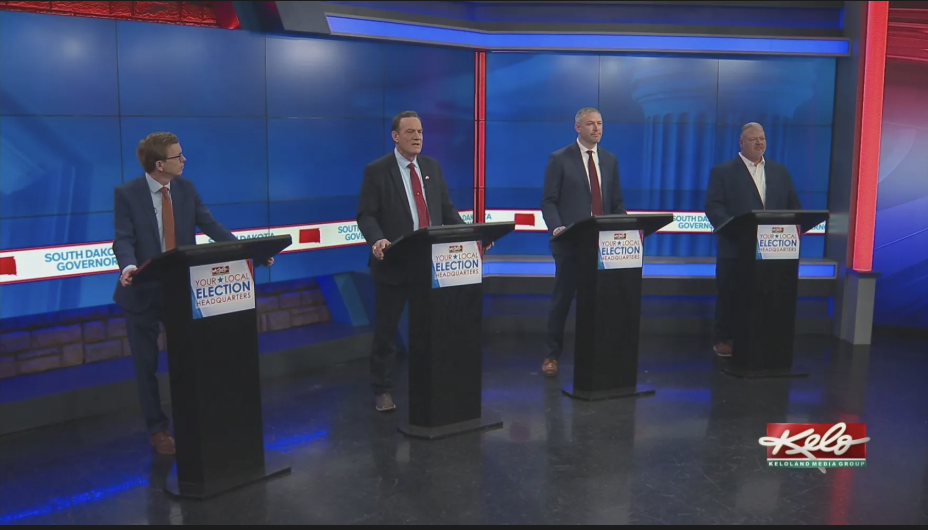

The four candidates vying for the Republican nomination for South Dakota governor met Tuesday in Sioux Falls in the first of three debates scheduled before the June primary election.
It was televised live from KELO-TV's studios, with news anchors Dan Santella and Lauren Soulek moderating.
Here are the top takeaways:
Trump and civil discourse
Gov. Larry Rhoden, House Speaker Jon Hansen and U.S. Rep. Dusty Johnson appeared to sidestep a question on how they can reconcile their support for President Donald Trump with his impact on political discourse in the country.
"I learned how to manage personalities. ... I've developed relationships to work with the whole spectrum of people," Rhoden said, citing his years of experience working in the Legislature and as governor.
Hansen also brought up his time in the South Dakota Legislature without directly addressing Trump.
"As Speaker of the House, I've led on a number of initiatives to advance the conservative agenda for South Dakotans. And to do that in the legislative branch, you have to work with people who don't always agree with you on everything," Hansen said.
Johnson voiced his support for Trump but added "that being said, it doesn't mean I agree with him on everything. It does mean I'll work with anybody to do good."
Meanwhile, Aberdeen businessman Toby Doeden doubled down on his support for Trump and dismissed criticism of his rhetoric.
"Donald Trump has brought back a culture of winning for the Republican Party. You don't have to agree with everything he says, you don't have to agree with every policy initiative, but, as a Republican, you have to respect what President Trump has done," Doeden said.
Trump has yet to endorse a candidate in the race.
Candidates clash over taxes
Perhaps the most contentious exchange of the night occurred when Johnson hit Rhoden and Hansen for legislation that recently passed the state Legislature aimed at property tax relief, accusing them of instituting the largest tax increase in the state's history.
"Jon and Larry have told you that they lowered your taxes, that's not true. ... They increased your taxes," Johnson said.
In an effort to address rising property taxes, the Legislature passed Senate Bill 96, which gives counties the option to implement a half-cent sales tax increase in exchange for lowering property taxes, and Senate Bill 245, which creates an owner-occupied property tax relief fund using revenue generated from the scheduled 0.3% increase in the statewide sales tax due to come into effect July 1. The passage of both bills came after negotiations between Rhoden and Hansen.
"When families like mine find out what was done, they are going to be furious," Johnson said.
Hansen hit back, accusing Johnson of being misleading in his characterization of Senate Bill 245.
"What Dusty just said is totally false," Hansen said. "We were trying to keep the tax down to 4.2%. When you couldn't get the tax down to 4.2% and it's going up to 4.5%, I led doing the next best thing, which is taking all of that revenue and putting it back into the people's pockets for property tax relief."
 Carson Walker
Rhoden labeled Johnson's comments "D.C.B.S." and highlighted that Johnson had come out with a nearly identical proposal.
"Representative Johnson, just a few weeks before we had laid out our proposal ... he laid out a proposal that used the exact same sales dollars for his property tax plan," Rhoden said.
Doeden also criticized the property tax proposals and reiterated his plan to eliminate property taxes altogether, in addition to scrapping sales taxes on groceries.
Education in South Dakota
When asked about the state of eduction in the Mount Rushmore state, Rhoden conceded South Dakota has been struggling when it comes to test scores but said adjustments to the curriculum could yield better results.
"We have moved to the science of reading and put phonics back in the classroom and we have gotten rid of common core and written new math standards, " Rhoden said. "One thing we won't do is what other states have done, as far as lowering the bar when their test scores haven't been what they should be."
Johnson said his initiative, Strong Schools, will look at the examples of other states that have seen substantial improvements in their test scores, such as Mississippi and Alabama, and apply those to South Dakota.
Trusted, independent sources of information are needed more than ever. Partner with us to produce fact-based news.
Doeden said he was in favor of spending "a lot of money educating our youth" but argued not enough was going to teachers.
"Our teachers have been underpaid and disrespected for decades," Doeden said, citing the low ranking the state has in teacher pay.
Doeden added that in addition to raising teacher salaries, more money should be allocated to improving rural school districts.
Hansen voiced his support for further investments in public education but said he felt superintendents should be held accountable for underperforming schools and that more resources could be allocated for those seeking non-public or home school options.
"Families ought to be in the driver's seat," Hansen said.
Data centers
On the issue of data centers, candidates varied between those optimistic of their economic benefits and those wary of the potential disruption to South Dakota's character.
When asked whether further incentives should be given to encourage data centers, Rhoden said he was "comfortable with the laws we have on the books right now" and dismissed concerns surrounding water and electricity usage.
"They are a valuable asset as far as economic development," Rhoden said. "We've struck a balance."
Hansen rejected giving any additional incentives to data centers and highlighted legislation he sponsored in the Legislature that enacted guardrails against potential utility and land changes as a result of such companies.
"I put my money where my mouth is this last session in Pierre," Hansen said. "When there were bills that were coming forward that wanted to give big tech companies massive tax breaks I fought those bills and I killed those bills."
While the Legislature passed Hansen's so-called Data Center Bill of Rights, the Legislature rejected several bills aimed at providing tax incentives to data centers.
 Alexander Rifaat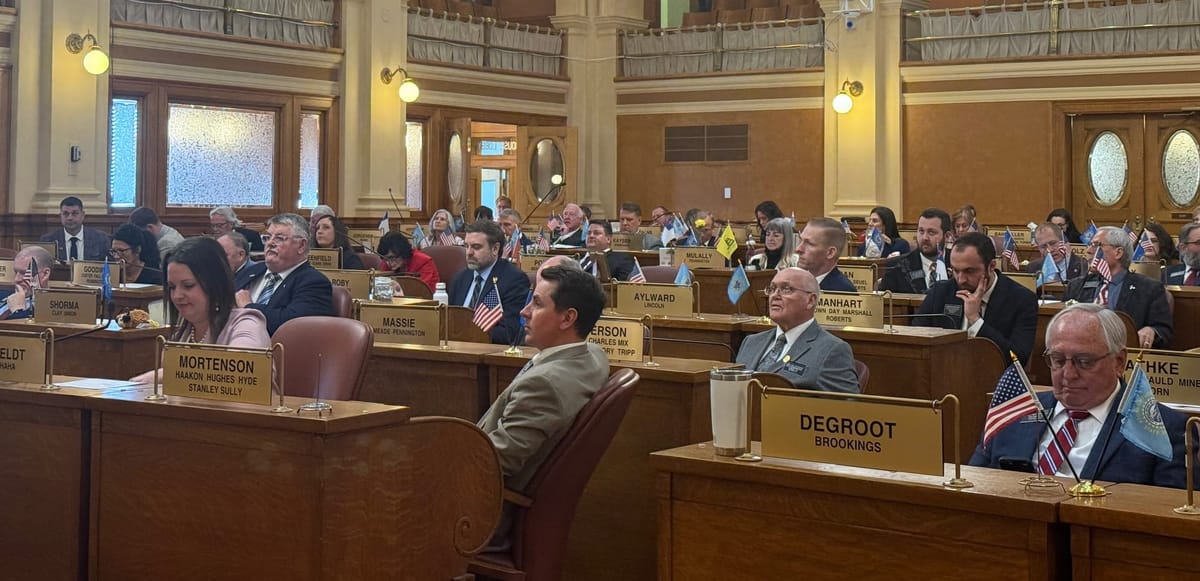
Hansen also suggested some of the data center-focused bills he helped to defeat in the Legislature would have benefited allies of Doeden.
Doeden dismissed Hansen's comments but did appear to agree that no additional subsidies should be given to large tech companies that are seeking to operate in the state.
"I will look at every, single economic opportunity that's available to the state, but there are a 100 ways to stimulate this economy. We don't have to build data centers to do it, "Doeden said. "I will never use a nickel (of) taxpayer money to subsidize Mark Zuckerberg, Google or any other out-of-state, billion-dollar company."
Johnson said that while he doesn't believe data center projects should be subsidized, South Dakota does need to foster a more competitive tax regime, given other states have been it more economically advantageous to operate elsewhere.
"This is the question: Where do you hit the Goldilocks spot," Johnson said, using North Dakota as an example of a state that has had, in his eyes, a positive experience with data centers.
Johnson also argued data centers could bring in additional tax revenue to the state.
Grading Noem
The final question of the night pertained to former Gov. Kristi Noem, who has received significant state and national attention in recent weeks given her ouster as secretary of the Department of Homeland Security and allegations surfacing around her personal life.
Each candidate was asked to give her a letter grade for her time as governor.
 Alexander Rifaat
Hansen gave Noem a "C," arguing it was only the Legislature that prevented her from enforcing stricter restrictions during the COVID-19 pandemic.
Doeden rebuffed Hansen, giving Noem "B" in part because her policies during COVID provided "hope" to the rest of the country.
Johnson declined to give her a grade but said Noem "has made some different decisions that I would have made. She's not perfect and Lord knows I'm not either."
Rhoden, who served as lieutenant governor under Noem, gave her an "A" and rejected Hansen's comments, saying he had a "front row seat" to her leadership during COVID. "She's got a spine of steel," Rhoden said.
Replay, next debates
Here's how to watch a replay of Tuesday's KELO-TV debate. The next televised debate with the candidates is Monday, April 13, in a forum moderated by South Dakota Public Broadcasting and South Dakota News Watch, which will be broadcast live on SDPB. A third debate hosted by The Dakota Scout and Forum Communications is scheduled for Monday, April 27.
The GOP gubernatorial primary takes place Tuesday, June 2. If no candidate wins 35% of the vote, the top two finishers advance to a runoff election scheduled for Tuesday, July 28.
South Dakota News Watch is an independent nonprofit. Read, donate and subscribe for free at sdnewswatch.org. Contact politics and statehouse reporter Alexander Rifaat: 605-736-4396/alexander.rifaat@sdnewswatch.org.