
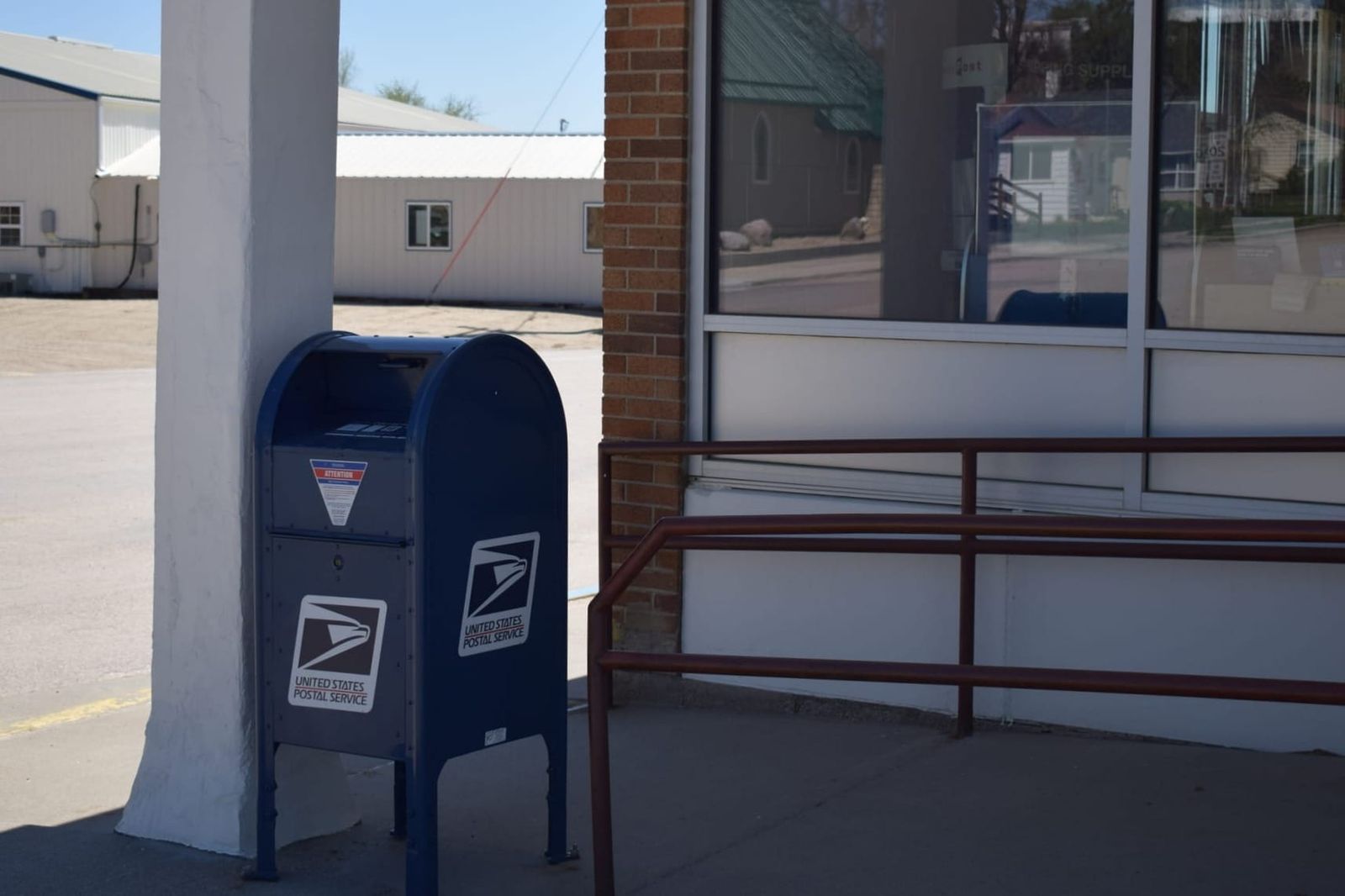
"It's common talk from the coffee shops to the business owners that the post office is still unreliable."

This story was updated on June 24, 2026, to reflect the fact that the U.S. Postal Service is now conducting an audit on delivery systems in South Dakota.
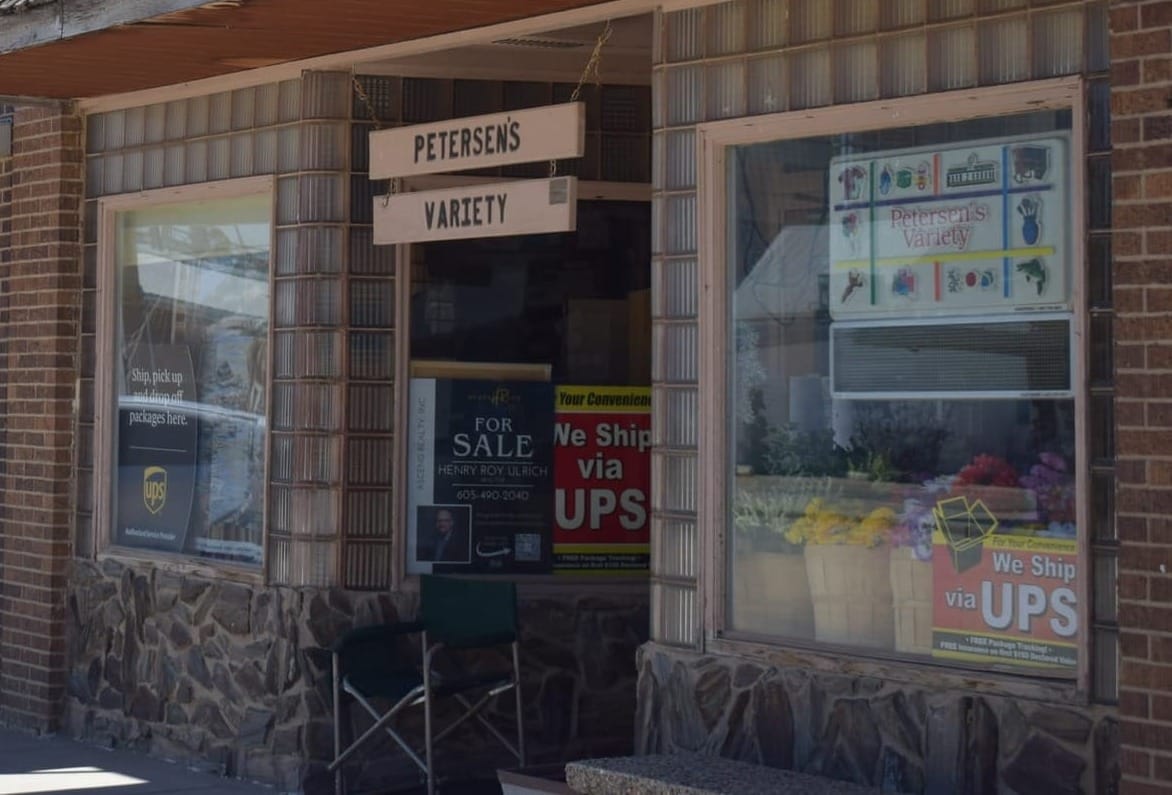
PHILIP, S.D. – At Petersen's Variety store, there are no less than three signs in the window advertising that residents of Philip can ship, pick up and drop off packages via UPS. The store is just a block away from the town's post office.
Residents in this western South Dakota town may be forgiven for choosing the – often more expensive – private shipping company over the nation's postal service: Long delivery times and unreliable service have led to growing distrust and dissatisfaction with the United States Postal Service's operations in rural parts of the state.
"There's no good news here. It's all bad news when it comes to the future, in terms of what they've done to the system, what it's costing, where they're at. And Congress is reluctant to do anything about it."
– David Bordewyk, executive director of South Dakota NewsMedia Association
In early 2024, USPS downgraded a distribution facility in Huron to a local processing-only facility. The service had also initially planned to downsize its Sioux Falls distribution facility but later said that the plan had been paused.
 Stu Whitney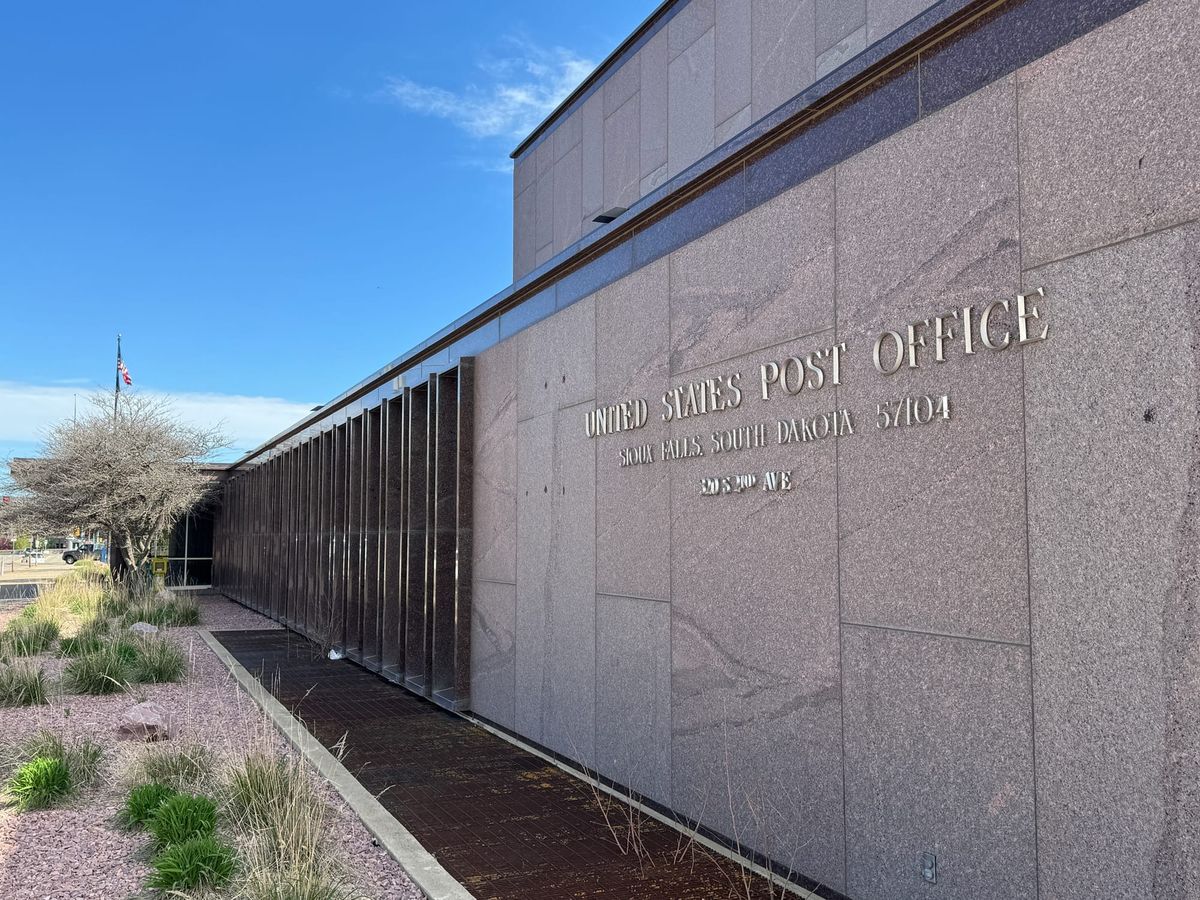
USPS spokesperson Tara Jarrett offered a few details on the impact of those changes in a statement to News Watch.
"Local mail continues to be processed in our Sioux Falls (570-571 ZIP Codes), Dakota Central (572-575 ZIP Codes), and Rapid City (577 ZIP Codes) plants, and that mail does not leave the state for additional processing if it is staying in that region," she said. "Mail in the 576 ZIP Codes continues to be served by our Bismarck, ND plant."
The organization has also recently begun rolling out its reduced service of rural post offices, stopping delivery vehicles at rural sites once a day, rather than twice.
The moves, which are part of USPS’s Delivering for America plan, aimed to “modernize the nation’s aged and neglected postal network.” But for thousands of people across the state, including dozens of local newspaper publishers, that effort has significantly hindered day-to-day life and operations.
West River publisher sees dramatic changes in delivery times
Don Ravellette’s family has been publishing papers out of Philip for nearly 50 years through the company Ravellette Publications. The Philip Pioneer Review, the company's primary imprint, now publishes news from Murdo, Wall, Bison, Kadoka and Faith.
The Pioneer Review is a true community paper: Recent stories include the details of a new lighted stop sign in Philip, the results of the Harding County regional high school rodeo and a story about how Murdo residents rallied together to clean up a city planter with new soil and flowers.
Get South Dakota news and information in a free email on weekdays. Cancel any time.
Ravellette said that for the past two years, he's been having a harder time making sure that news is delivered to subscribers in a timely manner. He's also chosen to regularly direct employees to drive to Wall to deliver papers. Ravellette said the town's 577 ZIP code – compared to Philip's 575 – means that subscribers receive papers in a timelier manner.
"More and more publishers have had to do that, this exceptional dispatch, where they're literally doing the work of what the post office used to do, in terms of taking these bundles to surrounding post offices. Just to try to get them to expedite the delivery, particularly in the local area," Dave Bordewyk, executive director of the South Dakota NewsMedia Association told News Watch.
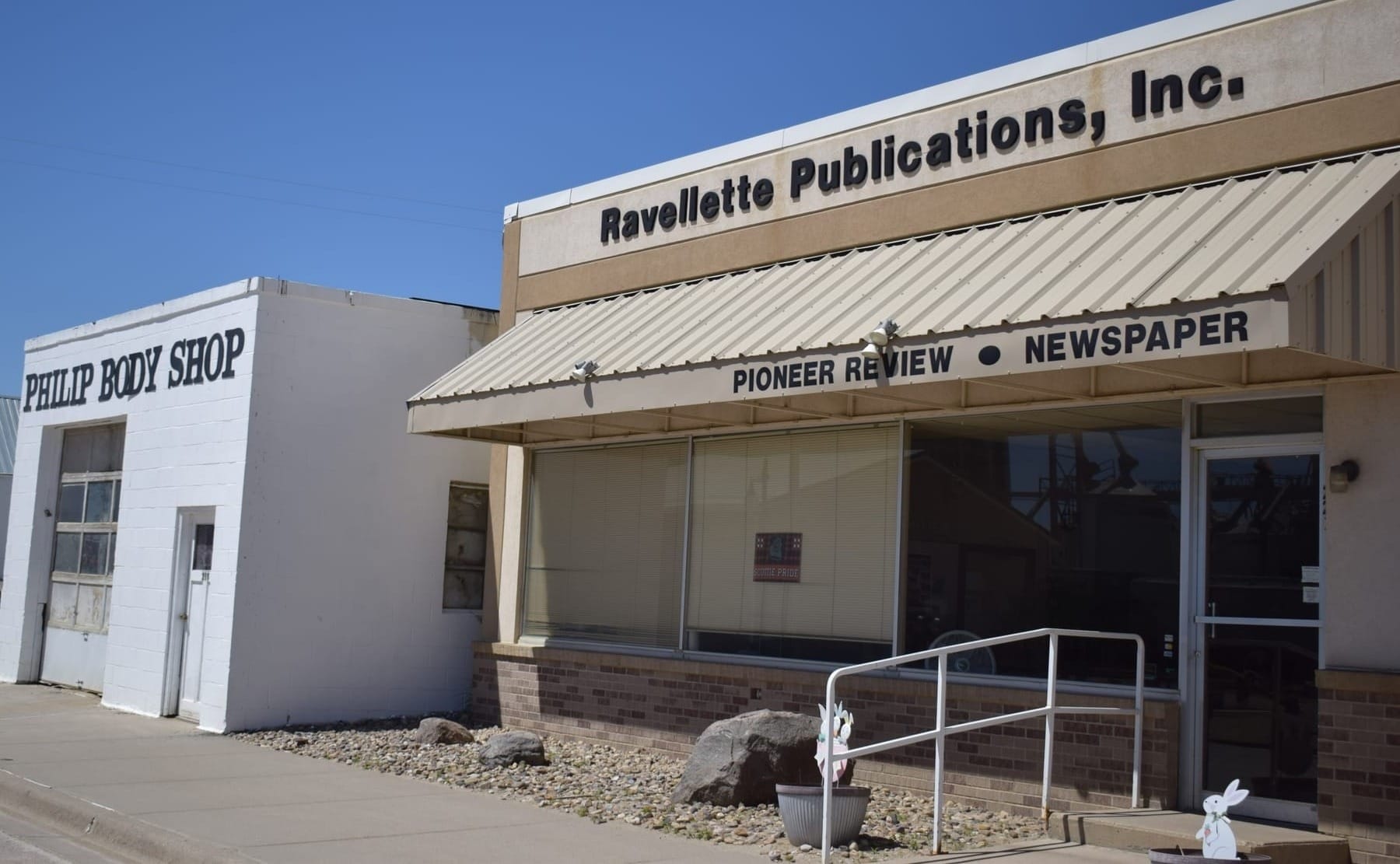
Ravellette told News Watch he is experiencing more frustration than ever before with the postal service.
"It's common talk from the coffee shops to the business owners that the post office is still unreliable. It's not even funny," Ravellette said. "And when we send out 1,000 livestock catalogs, it's sad when the out-of-state ones get delivered before the ones you mail out 25 miles from your house, from your post office."
In rural areas, the postal service is a lifeline because it is legally mandated to provide delivery and mail services to every ZIP code in the country. That means that routes cannot be discontinued or disrupted if they aren't used frequently or are not profitable.
Ravellette said that many of his subscribers do not see the value in having a weekly subscription to the newspaper when they can't expect it will arrive on time.
"They were saying, 'Well, we might just have to quit our subscription, maybe we'll just stop in and buy a paper whenever we can.' So there goes 50 bucks. And if you get 100 of those, you do the math," Ravellette said.
Ravellette said that he feels like decisions are being made at the national level that aren't considering the needs of rural America.
"They just won't listen. They just won't," he said.
Delivery worsened for 65% of papers that responded to survey
Ravellette is not the only publisher frustrated with the postal service.
Bordewyk recently sent a survey to members of the South Dakota NewsMedia Association, which includes 109 newspaper publishers and digital media outlets from across the state.
The organization had 64 publishers respond to the survey, of which about 65% said deliveries of their newspapers had worsened in the past year. Just 7% said deliveries had improved. Common complaints issued through the survey were inconsistencies with delivery times, struggles retaining advertisers and subscribers not receiving papers at all.
"I know there's information out there suggesting that we have good service in South Dakota. I reject that. I think the clear evidence is that the mail service is terrible in South Dakota."
– U.S. Sen. Mike Rounds
On June 4, Bordewyk met with the USPS Inspector General's office to discuss commonly expressed issues with the state's mailing system. He said that he thought the meeting went well and that the office seemed alarmed at publishers' complaints.
But he expressed concern at the organization's ability to fix what has already been broken.
"There's no good news here. It's all bad news when it comes to the future, in terms of what they've done to the system, what it's costing, where they're at. And Congress is reluctant to do anything about it," Bordewyk said.
USPS data shows meandering routes, longer delivery times
USPS’ Service Performance Dashboard provides data about on-time delivery rates for four types of mail shipped through the service: First Class Mail, newspapers and periodicals, marketing mail and bound printed matter, media and library mail.
A News Watch analysis of the data found that at the ZIP3 level, which is the first three numbers of a ZIP code, the percentage of on-time inbound delivery for newspapers and periodicals varies greatly across the state.
Inbound delivery times illustrate the average time it takes for papers and periodicals to arrive to addresses in a specific ZIP code. Just 57.81% of papers arriving to 575 ZIP codes arrived on time in the second quarter of 2026, compared to 86.37% in 570 ZIP codes. The ZIP3 code 575, where Philip is located, also sees the slowest average delivery time at 4.3 days this year.
Outbound delivery, though, which measures the timeliness of mail being sent from a specific ZIP code, is a reflection of the on-time rate that local papers can expect when sending their publications to subscribers from their town's post office. In the 575 ZIP3 code, the average delivery time for outbound newspapers this year is 5.3 days.
"All the newspapers mail us copies of their paper to the (SDNA) office here in Brookings," Bordewyk said. "One-hundred newspapers are sending them to us. It used to be by the end of the week, by Friday – because most weeklies would be printing and mailing on a Tuesday or Wednesday – we would see more than 90% of the newspapers. Today, by Friday, less than half of them are showing up."
Newspapers see much lower on-time delivery rates and more days to deliver than other tracked USPS mail types like First-Class Mail or marketing mail.
Ravellette shared a tracking number with News Watch for a package received by a rancher near Quinn, in western South Dakota. The package, which was shipped on July 28, 2025, from Phoenix, was received on Aug. 12, 2025.
The archive tracking statement for the package shows that it made its way through 14 cities on its way to Quinn. It notably ended up in Omaha, Nebraska, and Sioux Falls twice – once after making the 600-mile trip out to Billings, Montana.
The roughly 1,300-mile trip from Phoenix, the package's original destination, to Quinn turned into a 3,600-mile odyssey under USPS' care.
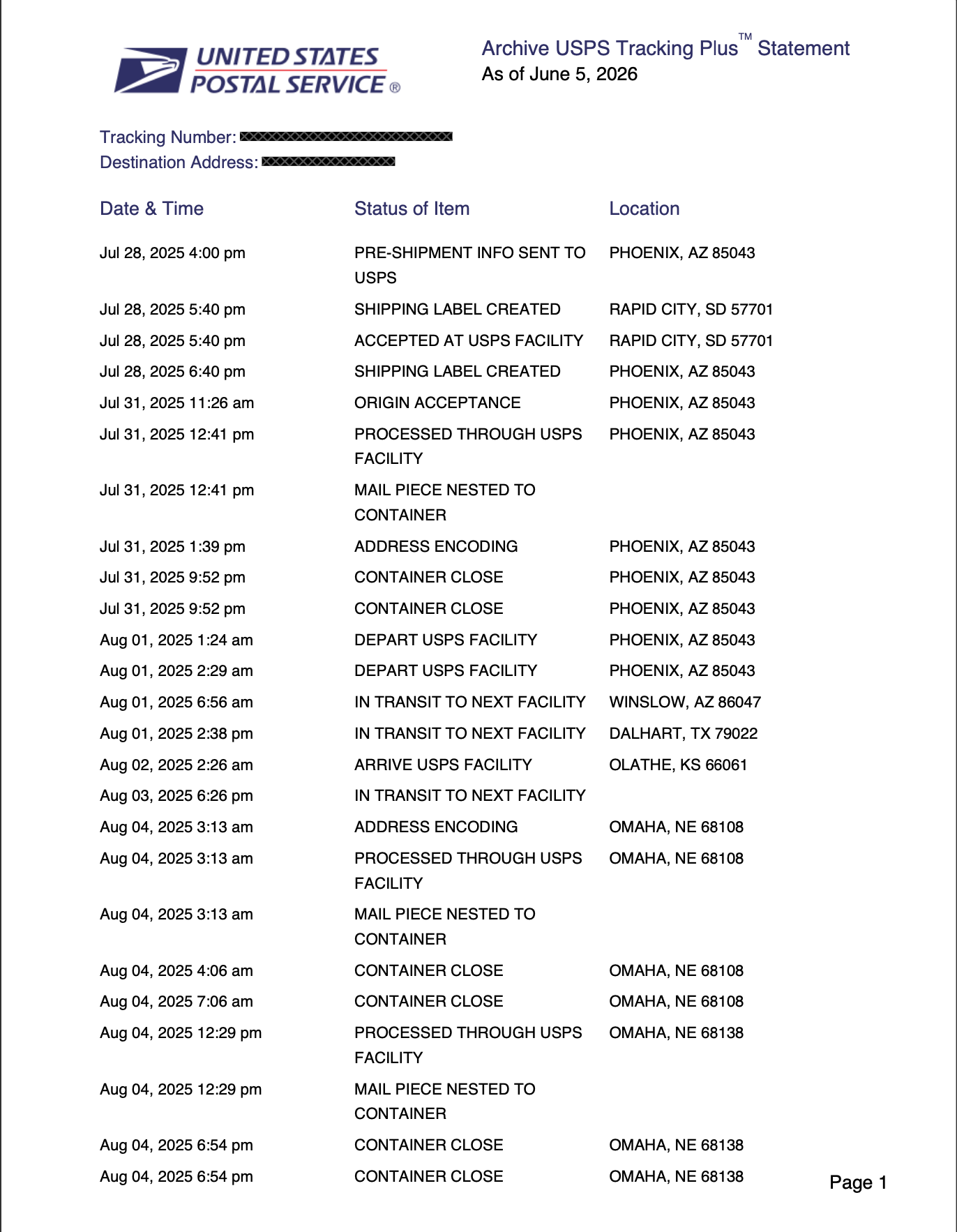
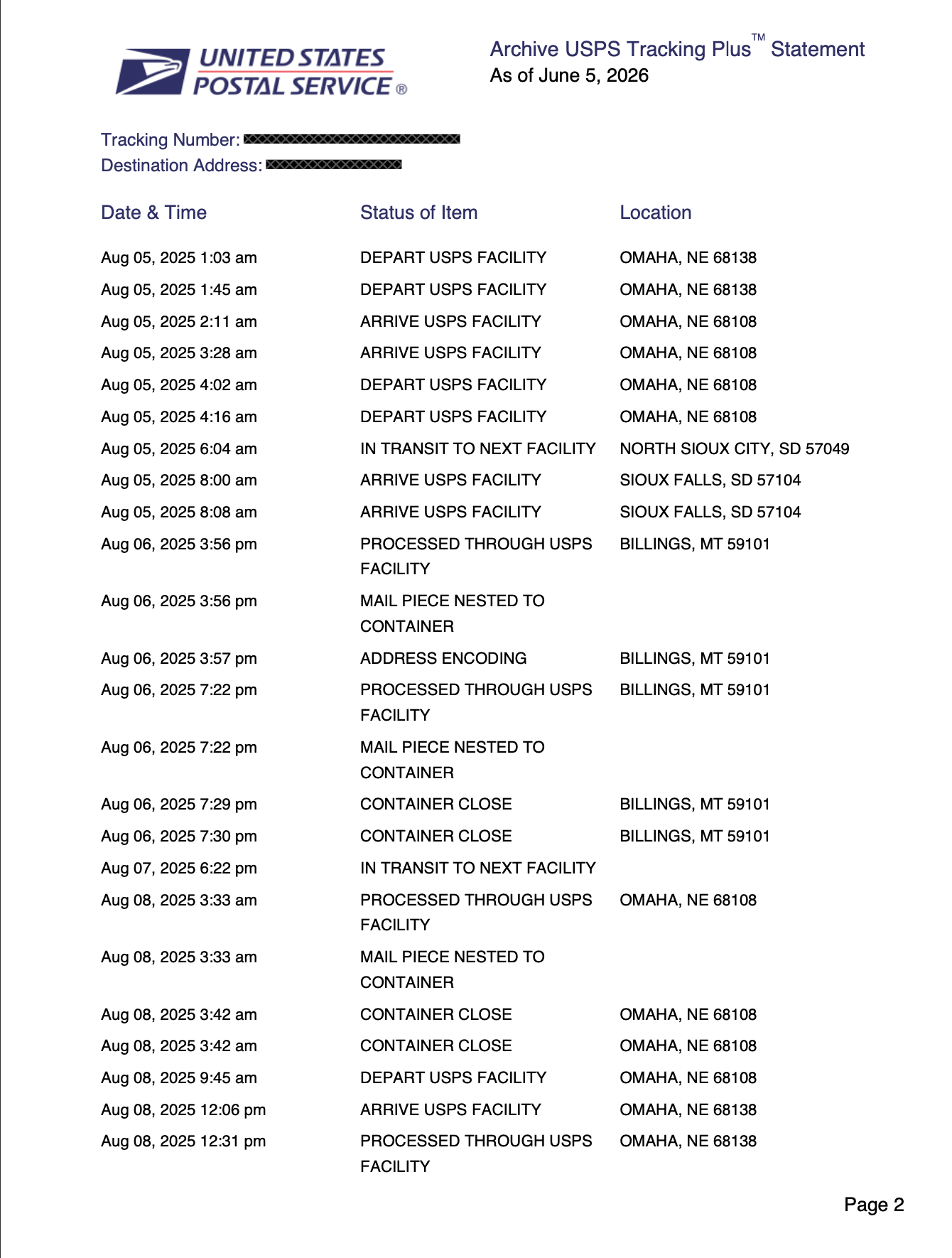
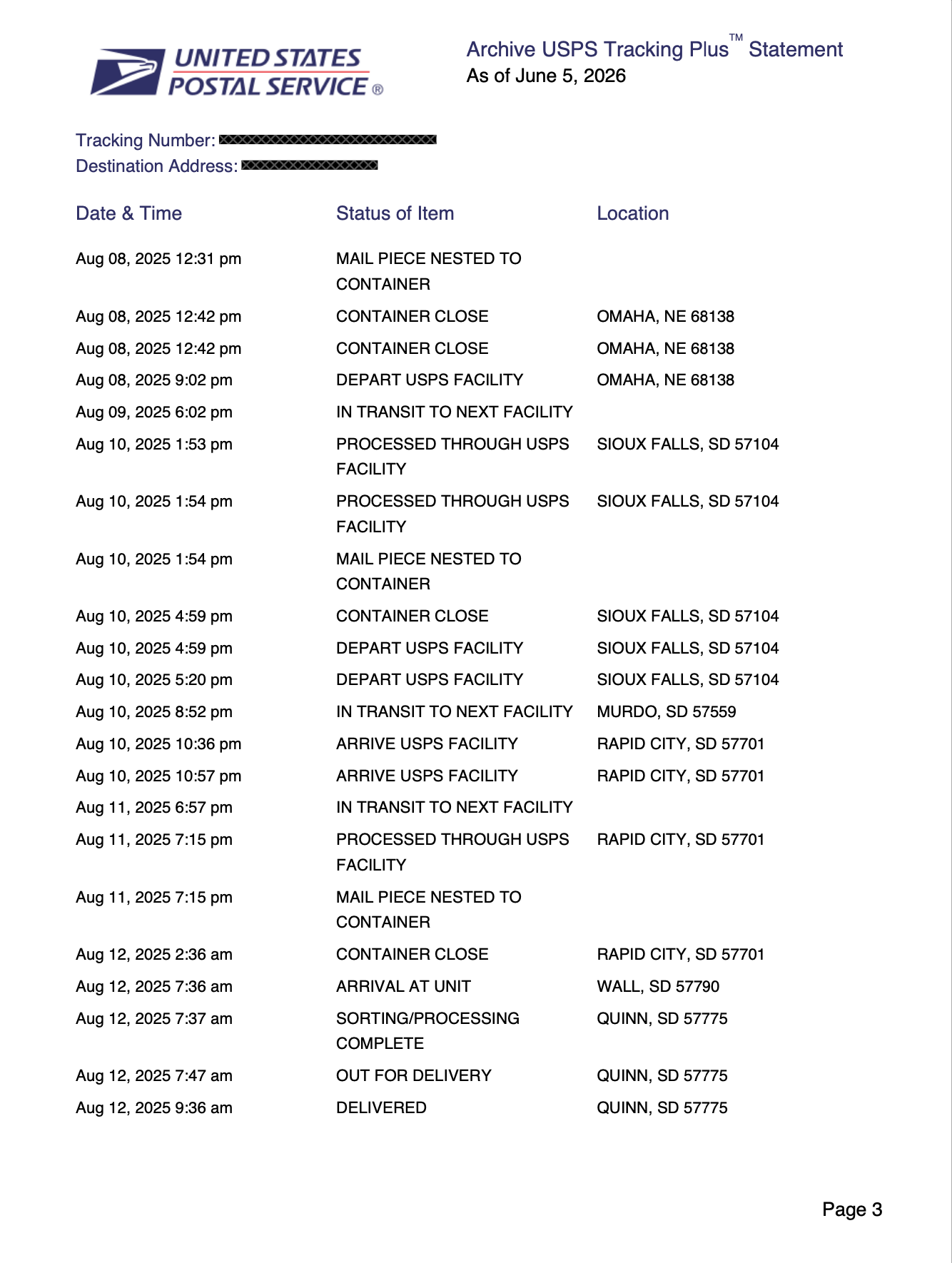
The archived tracking statement for a package sent from Phoenix, A.Z. to Quinn, S.D. on July 28, 2025.
USPS maintained in its statement to News Watch that its delivery performance in South Dakota is above average.
"USPS delivery performance in South Dakota is strong. About half of all First-Class Mail is delivered early. In the Sioux Falls area specifically, for the week ending 5/22/26, 92.6% of incoming mail was delivered on time, above our national target of 89%," Jarrett said.
The organization did not address questions about whether it is aware of issues in rural South Dakota and if there are any plans to speed up service in those areas.
South Dakota U.S. Sen. Mike Rounds told News Watch that he was unsatisfied with notions that the service in South Dakota was up to par.
"I know there's information out there suggesting that we have good service in South Dakota. I reject that," Rounds said. "I think the clear evidence is that the mail service is terrible in South Dakota."
Members of Congress looking for action
Rounds has previously been vocal about his dissatisfaction with USPS' performance in the state.
In a press release in December 2025, he said the service has “deteriorated to critical levels” in South Dakota. He also said that the Postmaster General David Steiner had "downplayed such issue existed in South Dakota."
Rounds called for an investigation into the service in the state, and the USPS Inspector General's office is now soliciting input from those with information about South Dakota's postal system, according to their Upcoming Audit Work page.
Rounds told News Watch, though, that he is aware of ongoing investigations in South Dakota. On June 11, he sent a letter to chairman Sen. Rand Paul and ranking member Sen. Gary Peters of the Senate Homeland Security Committee. In that letter, he said he would reject any nominations to four open postal service positions until a plan was in place to fix issues in South Dakota.
"I would, at this point, remind South Dakotans that your local postal employees are trying to help us," Rounds said to News Watch. "This is a systemic problem, and it has to be fixed with a systemic change."
The impact of slow USPS delivery extends beyond birthday cards and bank statements.
Support stories about rural South Dakota with a tax-deductible donation.
U.S. Rep. Dusty Johnson said in a column in January that he had surveyed 4,000 South Dakotans and held a roundtable in Sioux Falls where constituents shared issues with the postal service.
Many spoke of financial consequences, concerns with delayed medical prescriptions and other problems that have significantly impacted their day-to-day lives, he said.
"I heard from folks like Susan from Faulkton who incurred a $2,700 late fee because her check took 25 days to get to Sioux Falls. There’s a business in Bath whose customers often don’t receive their checks or get them two months late. And some people like Mary bought Christmas presents early, only to have them travel to nine different states before being delivered to Huron – 10 days late and after Christmas," Johnson wrote in the column.
Bordewyk said that while conversations with the Inspector General's office were generally reassuring, newspaper publishers across the state will still have to reckon with the fact that the system may never go back to the way it was – and be willing to make changes.
"The question for all of us is, will the postal service decide to walk back these system changes that they made?" Bordewyk said. "I understand your audience, your subscribers want that printed product, and that still serves a predominant need. But the move to a digital delivery is just going to be more and more necessary for even our smallest newspapers going forward. In order to survive, that's what's going to be necessary."
Correction on June 15, 2026: An earlier version of this story incorrectly identified Dave Bordewyk's position at the South Dakota NewsMedia Association. He is the executive director, not the president.
Molly Wetsch is a Report for America corps member who writes about rural and Native American issues for South Dakota News Watch. Your donation to match our RFA grant helps keep her writing stories like this. Contact Molly: 605-531-7382/molly.wetsch@sdnewswatch.org.