
The recently passed legislation gives counties the option to raise sales taxes in exchange for lowering property taxes, according to a new poll.

Editor's note: If you cite the results of this poll, credit South Dakota News Watch and the Chiesman Center for Democracy, per copyright law and our republishing policy.
PIERRE, S.D. – More South Dakotans disapprove than approve of recently passed legislation that gives counties the option to raise sales taxes in exchange for lowering property taxes, according to a new poll sponsored by South Dakota News Watch and the Chiesman Center for Democracy at the University of South Dakota.
The survey of 500 registered voters across party affiliation conducted April 7-9 by Mason-Dixon Polling and Strategy, found 49% of respondents opposed the swapping of lower property taxes in exchange for higher sales taxes, while 33% approved and 17% were undecided. The margin of error is plus-or-minus 4.5%.
In response to concerns over rising property taxes, Gov. Larry Rhoden and the South Dakota Legislature enacted a series of bills this past legislative session, including Senate Bill 96, which gives counties the option to implement a half-cent sales tax increase in exchange for lowering property taxes.
The new law received the highest level of support in the Sioux Falls metro area, with 40% approving, while East River North, at 26%, saw the lowest level of approval.
Julia Hellwege, director of the Chiesman Center and USD associate professor in political science, said the regional variation in support could be down to the structure of the legislation.
"This is not surprising as the proposal is likely to mainly benefit the metro areas. The governor’s proposal allows counties to make this property to sales tax swap, arguing this shifts the tax burden from the property owners to outsiders," Hellwege told News Watch. "However, as noted by some legislators during the session, the governor’s suggestion that these would be 'tourists' is less likely than these being rural residents who travel to the metro areas for shopping."
Republicans were close to evenly split, with 45% opposing the new legislation, 42% supporting the measure and 13% undecided.
A majority of Democrats and Independents disapproved of the new laws, at 56% and 51%, respectively.
 Alexander Rifaat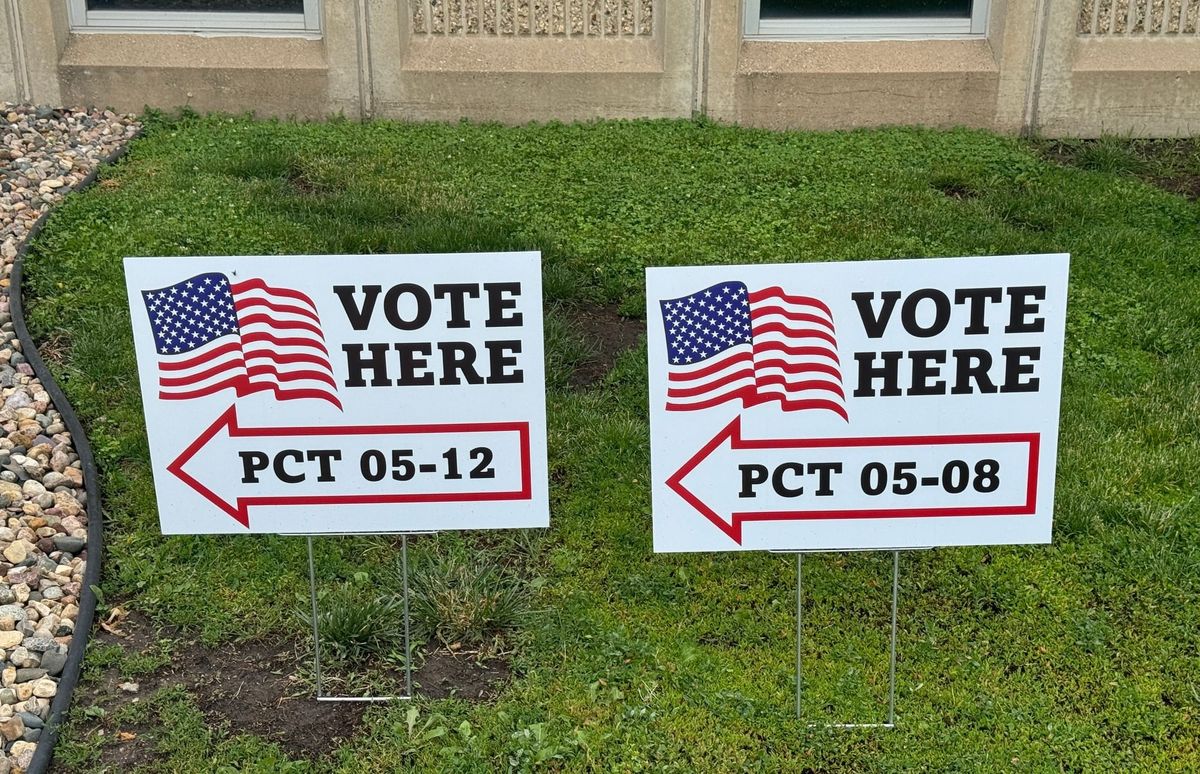
Brad Coker, founder of Mason-Dixon Polling and Strategy, ranked as one of the least-biased and most-factual pollsters, believes voter aversion toward the recent tax changes might be down to a preference for the status quo amid the risk of fixing one tax issue by creating another.
"You're not quite sure what can of worms you're opening when you start doing things like that," Coker told News Watch.
ICE, 'SAVE Act' and tariffs
Despite the various protests that broke out across the country earlier this year, a majority – 56% – of South Dakotans polled support local law enforcement cooperating with U.S. Immigration and Customs Enforcement officials.
A total of 38% of respondents disapproved and 6% were undecided.
Hellwege believes the low number of undecided responses underscores how important a topic ICE has become for voters.
"The ICE cooperation seems to be a salient issue for many, with fewer than 10% who are undecided, while most approve of the cooperation. It’s clearly not an overwhelming majority," Hellwege said.
South Dakota News Watch invests in scientific polls to let elected leaders know how constituents think they're doing and also survey people's opinions on important issues. But a good poll isn't cheap, so if you value these stories, please consider helping cover the cost. Thank you!
Disparities in support mostly fell along gender and party lines, with 65% of men supporting cooperation compared to 47% of women, and 76% of Republicans approving compared to 26% of Democrats. Meanwhile, 50% of Independents disapproved, 43% approved and 7% were undecided.
A vast majority of South Dakotans also approve of a new voter identification law.
Senate Bill 175, modeled after the "SAVE (Safeguard American Voter Eligibility) Act" pending in Congress, requires individuals to provide proof of citizenship when registering to vote.
In total, 63% of those polled approve of the new measure, with 34% disapproving and 2% unsure.
As with the question over ICE cooperation, the largest disparities were seen among gender and party affiliation.
Independents were close to evenly split, with 50% approving of the new measures, 49% disapproving and 1% unsure.
A slight majority of voters agreed with a recent U.S. Supreme Court decision that struck down tariffs imposed by Trump.
In February, the Court ruled the Trump administration could not unilaterally impose tariffs using the International Emergency Economic Powers Act (IEEPA). According to the poll, 52% of South Dakotans approved of the ruling, 38% disapprove of the decision, and 10% were unsure.
The level of support varied by region, with 61% of residents of East River South supporting the Supreme Court's decision, while 56% of East River North approved; 49% of those residing in the Sioux Falls metro area supported the ruling and 48% of West River residents backed the court's decision.
While South Dakota has overwhelmingly voted for Trump in each of the past three presidential elections, there were concerns his tariff policy was negatively impacting the state's agriculture industry.
Support for data centers scarce
The poll also indicated that South Dakotans remain wary of data centers, with 57% of respondents approving of measures that limit and regulate the construction of the buildings.
Approximately 20% of respondents disapproved and 23% were not sure.
The issue of data centers was a hotly debated topic in the 2026 South Dakota legislative session, with lawmakers falling either into a pro- or anti-data center camp.
Ultimately, Senate Bill 135, also known as the "Data Center Bill of Rights," was passed and signed into law by Rhoden. Championed by state House Speaker Jon Hansen and Senate President Pro Tempore Chris Karr, a Sioux Falls Republican, the law provides guardrails against data center electricity and water usage.
Support for limiting data centers was relatively similar across gender, party affiliation and age. By region, residents of the West River showed the greatest level of support for limiting data centers at 61%.

Coker was not surprised by the opposition to data centers in South Dakota.
"People don't like data centers. I've been polling this all over the country," Coker said. "I've seen these numbers before."
Hellwege said the relatively high percentage of undecideds indicates many South Dakotans have not made up their minds on whether to support data centers.
"Unlike ICE cooperation, this is clearly not a crystallized issue area for most people yet," she said.
Coming Thursday
Thursday's story will focus on South Dakota News Watch/Chiesman Center for Democracy poll results on voter sentiment regarding the state of democracy in America, whether legislators are addressing the state's most pressing issues and if lawmakers are being held accountable for their actions.
Previous poll stories
Alexander Rifaat Alexander Rifaat
South Dakota News Watch is an independent nonprofit. Read, donate and subscribe for free at sdnewswatch.org. Contact politics and statehouse reporter Alexander Rifaat: 605-736-4396/alexander.rifaat@sdnewswatch.org.