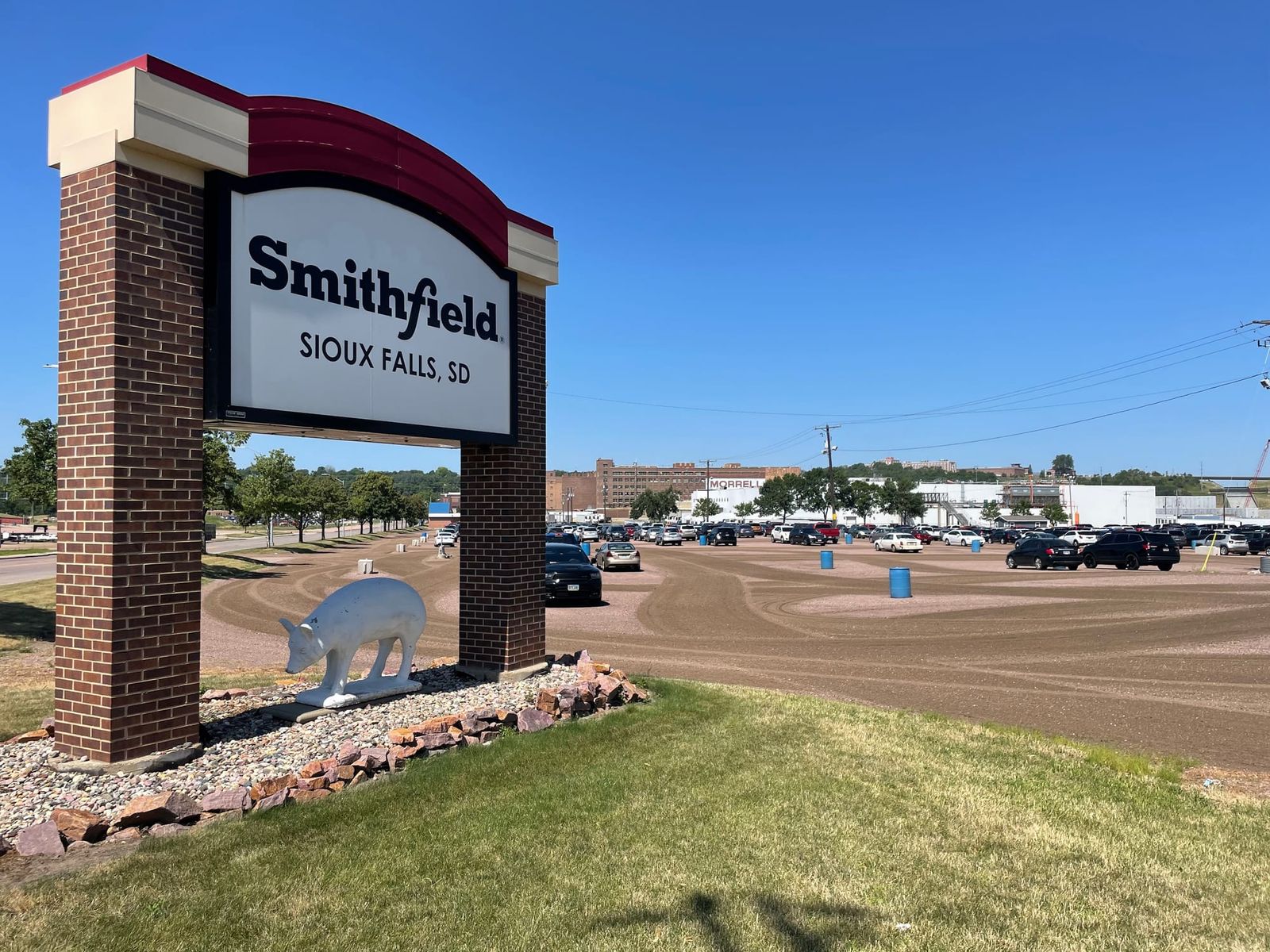

SIOUX FALLS, S.D. – Besides 120 acres of prime downtown real estate, Sioux Falls city leaders got something that has sometimes been elusive over the history of the Smithfield pork plant: an assurance that it's not leaving.
That's also good news for hundreds of farmers in three states that supply the 20,000 hogs slaughtered each day at what is one of the oldest and largest meatpacking plants in the country.
On Feb. 16, South Dakota Gov. Larry Rhoden, Sioux Falls Mayor Paul TenHaken and Smithfield Foods CEO Shane Smith announced that Smithfield's pork processing facility would move out of its century-old campus just north of Falls Park to a new location in an industrial park in northwestern Sioux Falls.
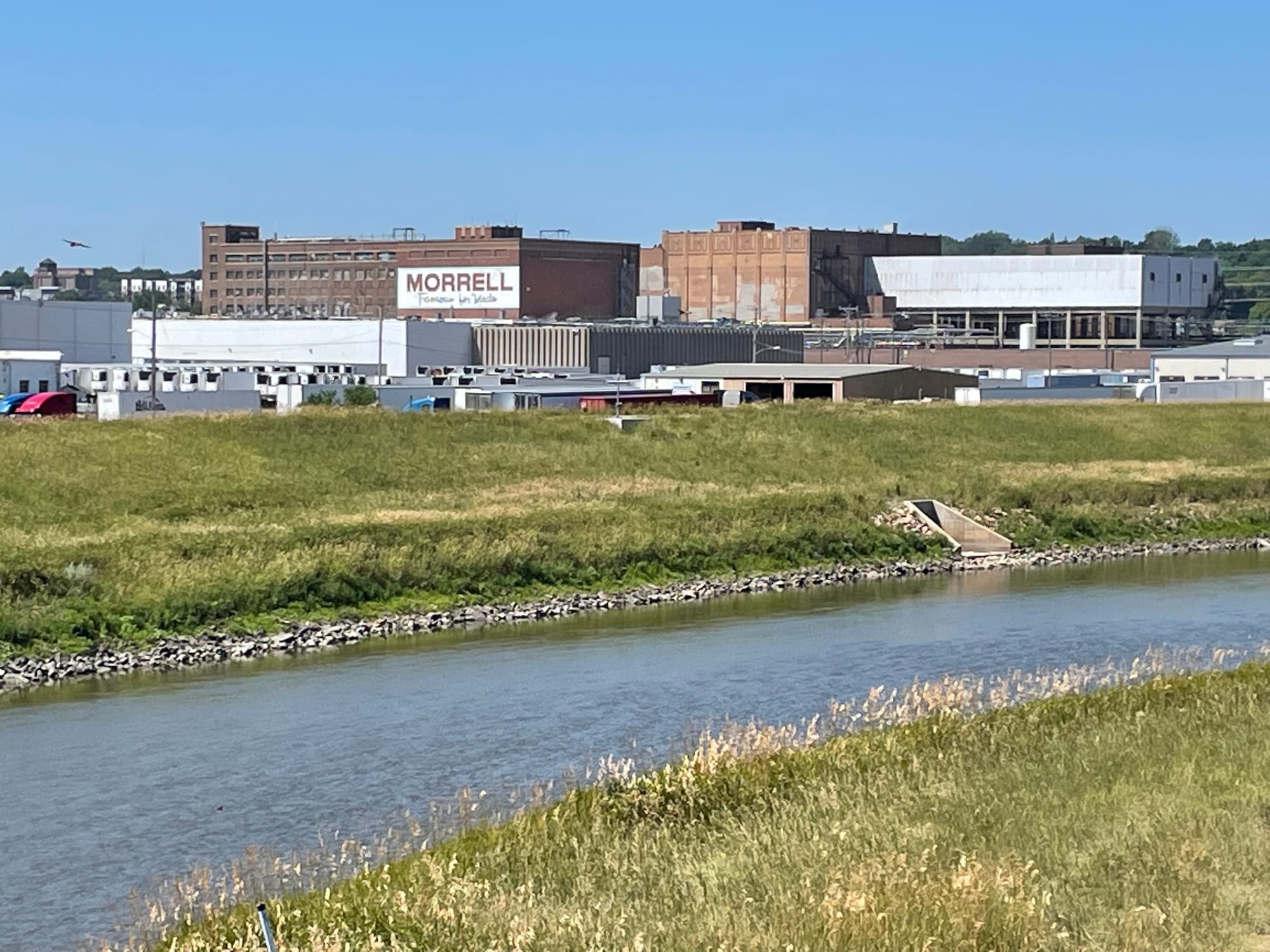
The downtown Sioux Falls site opened as John Morrell & Co. in 1909 and was purchased by Smithfield Foods in 1995.
The plant employs about 3,200 people, which puts it third in the top Sioux Falls employers not accounting for public institutions. It’s Smithfield’s second-largest processing facility and the largest producer of packaged meats in the country.
The new facility will be even larger, with an estimated $1.3 billion price tag on 200 acres.
The move, which will be possible in part thanks to a $50 million gift from billionaire Denny Sanford, raises questions for both Sioux Falls and South Dakota residents, especially for those familiar with the company's long history and deep impact in the area.
What is Smithfield's environmental impact?
Not surprisingly, any operation that slaughters thousands of head of livestock every day has an impact on the environment, and the plant has had issues with air and water pollution. Residents of the area are familiar with Smithfield's signature smell, which often wafts across downtown when the wind blows the wrong way.
The new plant will be markedly less smelly, Smithfield representatives said to city council, thanks to air-scrubbing technology that can be housed in a newly constructed facility.
The current site sits directly on the Big Sioux River, the state's most populated river basin. More than 40% of South Dakota's population lives in the river's watershed, which stretches across an area the size of New Jersey. The new location will place it about 3 miles away from that waterway and a mile from the nearest tributary, which is Willow Creek.
Smithfield uses an estimated 3 million gallons of water a day, according to Friends of the Big Sioux River.
Under the Clean Water Act and Clean Air Act, the company must acquire permits for its wastewater discharges and emissions from the South Dakota Department of Agriculture and Natural Resources. Smithfield has run into compliance issues for those permits in the past.
In 2018, DANR fined Smithfield $55,382 for violations of its discharge permit stemming from a wastewater treatment failure. In 2011, the company was fined $44,000 for numerous permit violations, including for ammonia release violations.
At one point in time, it ranked first in the nation for total releases in the food industry. But the company has reported vast improvements in its adherence to environmental guidelines.
 Stu Whitney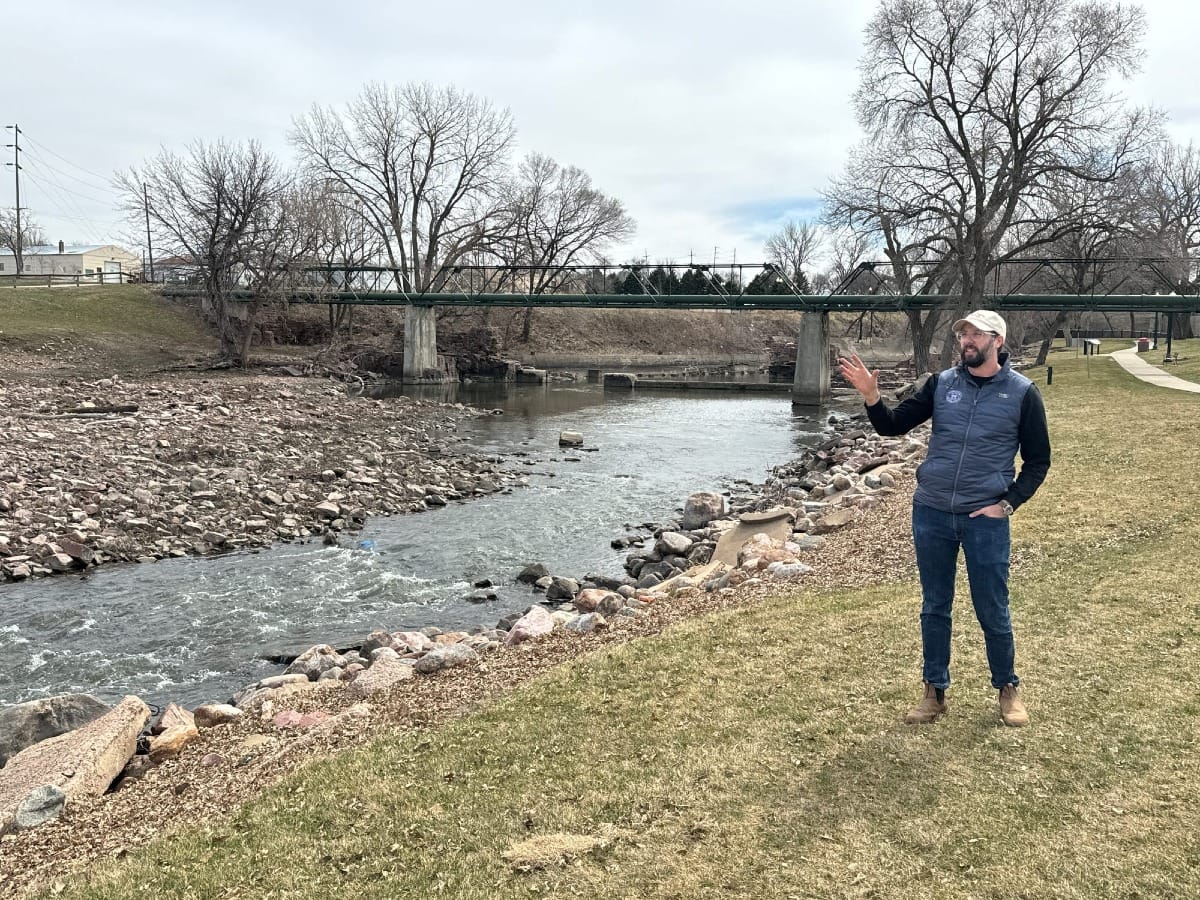
The city of Sioux Falls plans a $90 million tax increment financing (TIF) district for the new campus, which Smithfield said would go toward funding a new wastewater treatment facility. The company previously spent $45 million on the construction of a wastewater treatment facility at the current site just three years ago.
Ray Atkinson, senior director of external communications for Smithfield, told News Watch in 2024 that the new facility had resulted in a 47% decrease in nitrate discharge to the Big Sioux River.
"The $45 million investment we have made in Sioux Falls is one of the largest infrastructure projects to have a direct impact on water quality in the Big Sioux River and has significantly reduced nutrient discharges and improved water quality in the Big Sioux River basin," Atkinson said at the time.
Sioux Falls city councilors were briefed on the TIF district proposal by the Planning and Development Department on Feb. 17.
Choose how to give. Click the Donate button to see the different ways you can give and help make stories like this one possible. And tell us why you support our work.
City staff will formally bring the proposal to the city planning commission on March 4. If it passes there, it will see hearings in front of city council later in the month. On Tuesday, Minnehaha County commissioners said that the TIF was "absolutely necessary."
DANR did not respond to multiple requests for comment over the past week by the time of the story's publication.
Travis Entenman, executive director of Friends of the Big Sioux River, told News Watch that while the plant has historically been associated with river quality due to its high levels of wastewater discharge, the facility's move will not likely have a major impact on the river's quality. That's because of agricultural runoff at farms farther upstream, which contribute to the majority of harmful elements, Entenman said.
"This won't solve all of our river issues in terms of quality. I always hammer on that there's upstream and downstream things we need to be doing to really have a large scale impact," he said. "It's just a small drop in the bucket compared to everything that's going into it."
That doesn't mean that the move is unwelcome, though, Entenman said, if unexpected. When speaking to News Watch in 2024, he said that he did not think it was likely that Smithfield would move out of its downtown location.
"It's something I don't think I was expecting anytime soon. The idea that now they are going to go to a completely new facility, it's just a wonderful surprise," Entenman said.
Now, the dreaming can start for increased access to the river for pedestrian and recreation activities, Entenman said. Those access improvements will take time. The site will first need to be demolished and its environmental conditions assessed. Mayor TenHaken said the development process would take "several decades."
What is Smithfield's statewide impact?
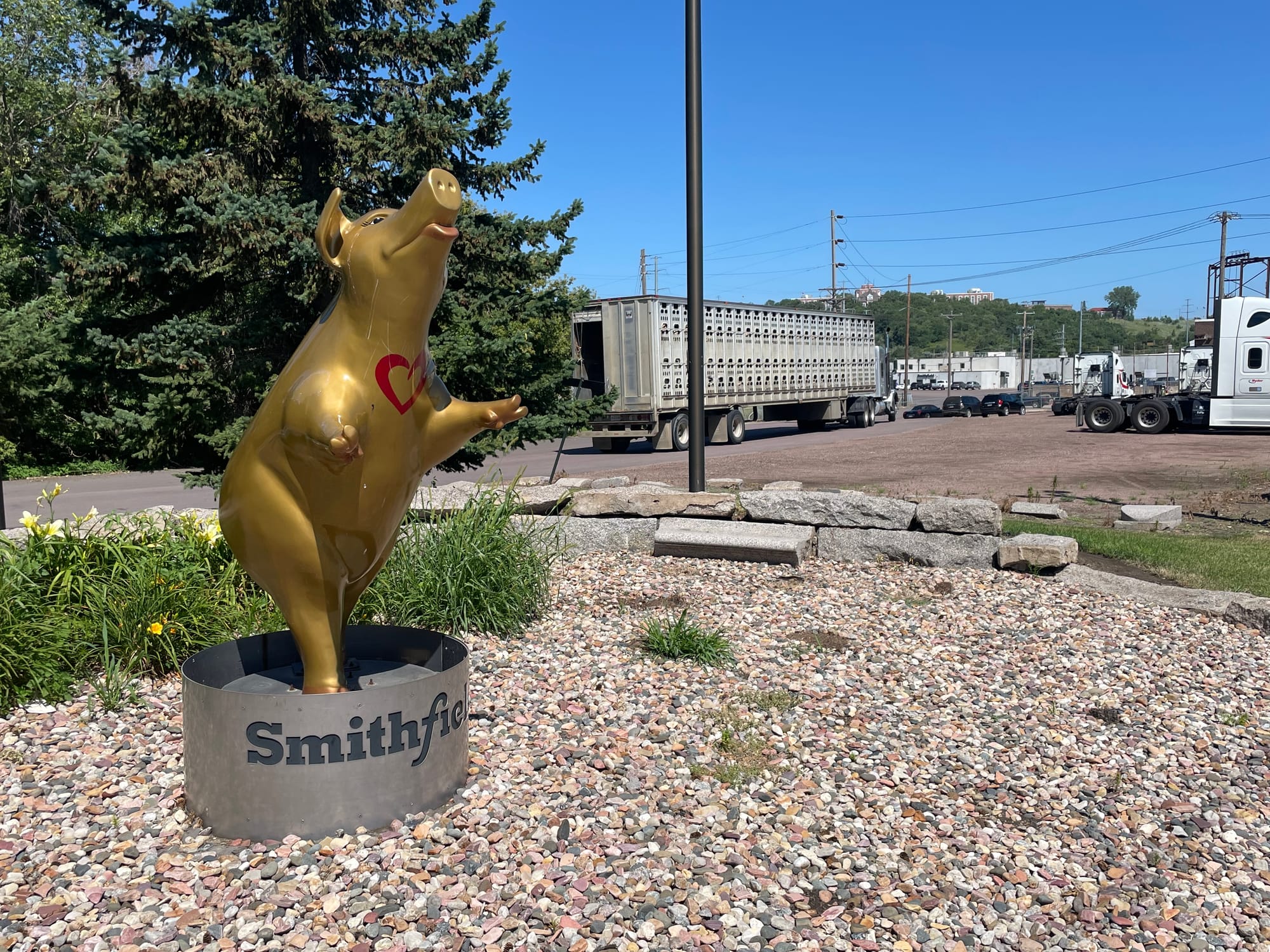
Though Smithfield's operations in the state have shifted vastly – ranging from cattle, pork and sheep processing at its inception to its current output of more than 20,000 hogs a day – it has remained a key figure in the state's agriculture industry.
The plant works with more than 500 independent farmers in the region. Emma Davis, a representative for Smithfield Foods, told News Watch in a statement that most of the livestock comes from local farmers.
"The vast majority of hogs we process in Sioux Falls are from independent hog producers in South Dakota, Minnesota and Iowa," Davis said.
There are also eight contract farms in the state, which are those that have exclusive agreements to provide hogs to Smithfield. Nationwide, the company has 250 contract farms.
Pork is far from the biggest moneymaker in the state's large agricultural industry, which makes up nearly 14% of the state's GDP. That title belongs to cattle, corn and soybeans. But Davis said that the local farming and agriculture economy gets a net benefit from the facility operating in the state.
"The proposed combined fresh pork and packaged meats facility will be the most modern of its kind in the United States and will support independent hog farmers, corn and soybean producers (that provide the grain we use to feed our animals) and other agricultural sectors that fuel the pork supply chain in South Dakota and the surrounding region," Davis said.
The new campus' impact will largely be felt in Sioux Falls, as the 120-acre site vacates and begins the slow redevelopment process in the next few years. The downtown land will be purchased by the Sioux Falls Development Foundation using Sanford's donation and will essentially double the current downtown area, TenHaken said.
Other, smaller communities might also see changes, though.
The neighboring town of Crooks, which sits about 12 miles outside of Sioux Falls with a population of 1,679, will soon be next-door neighbors with Smithfield. The town's city limits sit just at the edge of the new plant, and the Crooks City Council is hosting a public meeting March 9 to discuss the move, according to the meeting agenda.
What is Smithfield's economic impact?
The plant has long been an economic heavy-hitter: Smithfield said the Sioux Falls facility generated $4.4 million in taxes in 2024 and pays about $200 million in wages yearly.
Smithfield was notably purchased by China-based WH Group for $4.72 billion in 2014. Smithfield retains its headquarters in Virginia, and its website states that "Smithfield has not, does not, and will not import any products from China to the United States. No Smithfield products come from animals raised, processed or packaged in China.”
In 2020, the facility closed for about three weeks after COVID-19 broke out among employees. During that time, the company said that the plant processed 4-5% of the country's pork. It employs more than 3,200 people in Sioux Falls, making it one of the area's largest employers – just behind health care giants Sanford Health and Avera Health and the Sioux Falls School District.
 Molly Wetsch
Smithfield plans to spend $1.3 billion to construct its new facility. The new plant will sit in Foundation Park, an industrial park that houses an Amazon distribution warehouse, FedEx and the future site of CJ Schwan Foods' production facility.
TenHaken said in his speech Feb. 16 that had the company chosen to move out-of-state rather than stay in Sioux Falls, the state would likely have seen a multi-billion dollar economic loss. He cited the closure of a similarly-sized Tyson beef processing plant in Nebraska, which the University of Nebraska said cost the state $3.3 billion.
"I don't want to just take for granted that it was assumed that Smithfield would stay here, because it wasn't," TenHaken said.
South Dakota News Watch is an independent nonprofit. Read, donate and subscribe for free at sdnewswatch.org. Contact reporter and Report for America corps member Molly Wetsch: 605-531-7382/molly.wetsch@sdnewswatch.org.