

Five months after Operation: Prairie Thunder officially began, the South Dakota Highway Patrol's collaborative anti-crime and immigration enforcement effort will continue into the new year, the governor’s office has confirmed.
The program was originally announced by Gov. Larry Rhoden to take place from July 28 through December.
One portion of Operation: Prairie Thunder involves the state's entrance into multiple 287(g) agreements with U.S. Immigration and Customs Enforcement that allow ICE to delegate some authority to state and local law enforcement agencies.
That happened as immigration enforcement operations ramped up after the inauguration of President Donald Trump, who nominated former South Dakota Gov. Kristi Noem as the Department of Homeland Security secretary.
Under Trump and Noem, more than 500,000 people have been deported from the country, according to Homeland Security, which has not released state-by-state deportation numbers.
ICE arrest data indicates focus on Hispanic, male individuals
In South Dakota, ICE and Homeland Security have been visible, especially in small towns in the eastern part of the state.
In July, ICE confirmed an active investigation at the Trail King Industries Inc. manufacturing plant in Mitchell, though no further information has been released about whether that investigation resulted in arrests, detainments or deportations.
In May, Manitou Equipment and Global Polymer Industries in Madison saw eight people arrested on immigration charges.

And in October, Drumgoon Dairy near Lake Norden confirmed that the company had been subjected to an immigration audit by Homeland Security, which is not the same as an immigration raid. But it resulted in the forced termination of 38 employees with citizenship information that was outdated, inaccurate or incomplete.
While nationwide ICE arrests and deportations have targeted a wide variety of individuals from multiple countries – including in neighboring Minnesota, where Somalian people have been the most recent target of ICE operations – South Dakota arrests have involved nearly all Hispanic people.
Most recent ICE arrestees in South Dakota are citizens of Mexico and Central America, with the majority coming from Mexico and Honduras, and 98% are male, according to government data obtained via a FOIA request from the Deportation Data Project and analyzed by South Dakota News Watch.
The project currently retains accurate state-based data from July 1 to Oct. 15. The data cannot accurately reflect any arrests prior to July 1 but can help to understand general arrest trends in South Dakota.
Hispanic people across the state have reported feeling less safe, said Ivan Romero, vice president of the South Dakota Hispanic Chamber of Commerce. The Latino Festival and Parade, which is hosted in Sioux Falls by the South Dakota Hispanic Chamber of Commerce, was canceled this year due to safety concerns, Romero told News Watch in October.
 Molly Wetsch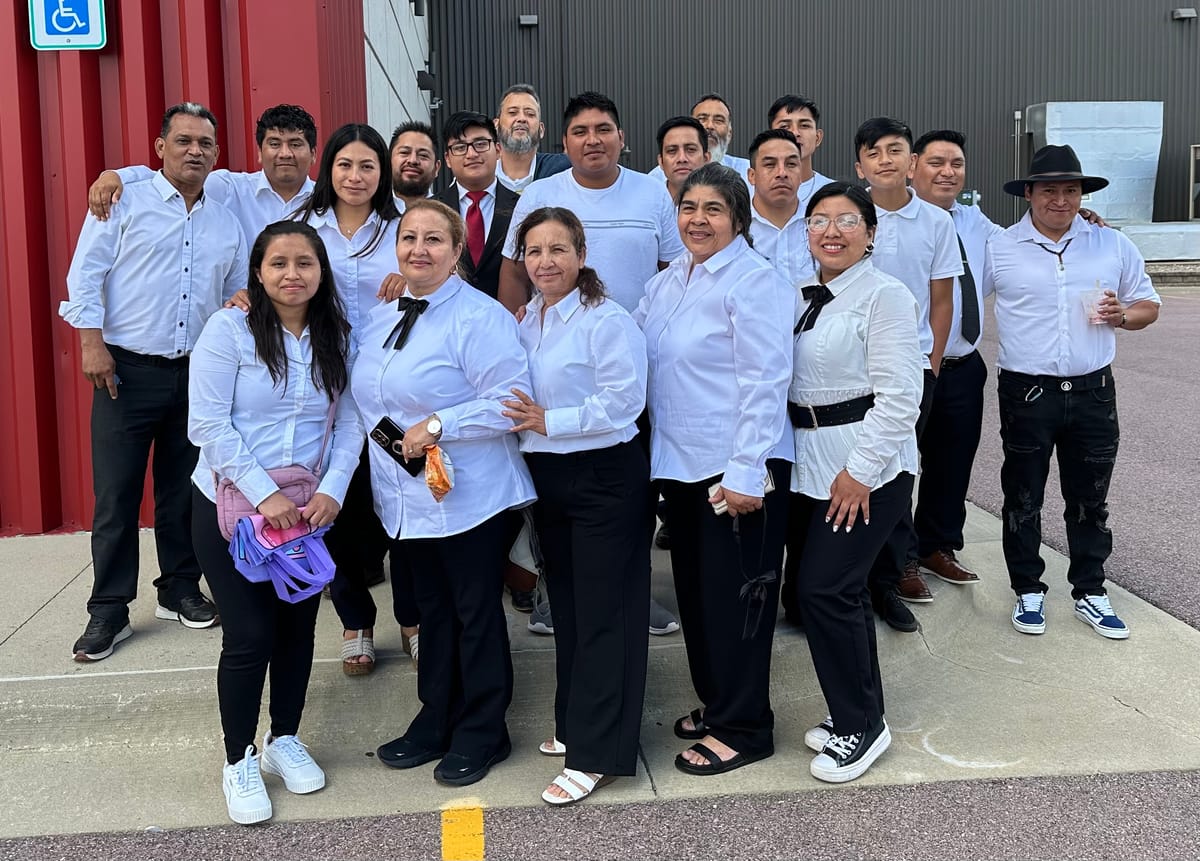
"That was unfortunate, but people just don't feel comfortable coming to Sioux Falls at this point," he said.
The vast majority of detainer requests from July 1 to Oct. 15 went to the Minnehaha County Jail in Sioux Falls, followed by the Pennington County Jail in Rapid City and the South Dakota State Penitentiary in Sioux Falls.
The Deportation Data Project defines detainer requests as “all requests to state, county, and municipal jails and prisons either for a person to be held on a detainer or for a notification of release date and time. A detainer is a request to a local jail to hold someone for 48 hours beyond when they otherwise would be released so that ICE can make an arrest in the jail while the individual remains detained.”
ICE said that detainer requests are most often lodged against an individual in an agency's custody that poses a "public safety threat." Other Homeland Security agencies can issue detainers, but most come from ICE, according to the agency's website.
Operation: Prairie Thunder focuses on drug operations
To date, ICE has signed more than 1,200 287(g) agreements with agencies in 40 states, including five with various South Dakota agencies enabling parts of Operation: Prairie Thunder.
Those agreements take three different forms:
- Task Force Agreement: The "force multiplier" program that allows law enforcement officers to adopt limited immigration enforcement duties, with ICE oversight. The South Dakota Highway Patrol signed this agreement on May 22 and the South Dakota Department of Criminal Investigations signed it on June 11.
- Warrant Service Officer: Allows law enforcement officers to execute warrants on behalf of ICE on individuals in their agency's jail. The South Dakota Department of Corrections signed this agreement on Aug. 28, the Minnehaha County Sheriff's Office signed it on March 17 and the Hughes County Sheriff's Office in Pierre signed it on March 7.
- Jail Enforcement Model: Allows law enforcement officers to identify and process individuals who may be in violation of immigration laws while they are serving time in their agency's jail. The DOC signed this agreement on July 25.
While Operation: Prairie Thunder's immigration enforcement prong has been well-publicized in the state, the majority of the program's activity comes from enhanced traffic monitoring and drug enforcement, according to data released from the governor's office.
According to a press release from Operation: Prairie Thunder, 260 of 406 – 64% – of individuals currently in custody as a result of Operation: Prairie Thunder have a drug charge and 156 have been cited with a drug charge and released. More than 2,000 traffic citations have been issued.
The “ICE Contacts” section of Operation: Prairie Thunder’s most recent dataset said that 89 people had been contacted in ICE-related situations since the program was announced. A representative from the Department of Public Safety told News Watch in a statement: "The intent of (Operation: Prairie Thunder) is to reduce crime in our communities.
"It is important to note that any ICE contacts are incidental contacts – we aren't seeking out illegal aliens during the saturation patrols. However, the 287(g) agreement allows us to coordinate swiftly with ICE if a stop uncovers undocumented individuals. Those undocumented, non-citizens, are the people counted as 'Individuals Contacted.' Not all of those found to be undocumented are taken into custody, per ICE guidance, therefore the ‘Contacts’ and ‘Arrests’ sections differ."
The program, which initially concentrated most of its efforts in Sioux Falls and the surrounding area, has started other efforts across the state.
Operation: Prairie Thunder most recently carried out operations in Belle Fourche, Huron and Yankton, where 75 individuals were taken into custody, 42 with a drug charge. Twenty-seven people were identified as ICE contacts.
The city of Brookings issued a statement on Dec. 12 that the operation would be coming to town Dec. 17-19 and that the city "would not be participating."
Josie Harms, Rhoden's press secretary, said the ongoing arrest and citation statistics indicate successful crime-fighting efforts.
"Our results remain impressive, and it is clear that this operation is keeping South Dakota strong, safe, and free — so we are going to keep it up," Harms said in a statement.
This story was produced by South Dakota News Watch, an independent, nonprofit organization. Read more stories and donate at sdnewswatch.org and sign up for an email for statewide stories. Investigative reporter Molly Wetsch is a Report for America corps member covering rural and Indigenous issues. Contact her at molly.wetsch@sdnewswatch.org.